

What does a tender writer actually do? (and do you really need one?)
Many business owners assume a tender writer simply "writes the words" before submitting a bid. In reality, that's only a small part of the job.
A good tender writer is part strategist, part project manager, part editor and part compliance expert. Their role is to help you present your business in the strongest possible light while ensuring your submission meets every requirement of the request documentation. So, what does a tender writer actually do? And more importantly, is hiring one worth it? Here’s the low down.
f you've never worked with a professional tender writer before, you're not alone.
Many business owners assume a tender writer simply "writes the words" before submitting a bid. In reality, that's only a small part of the job.
A good tender writer is part strategist, part project manager, part editor and part compliance expert. Their role is to help you present your business in the strongest possible light while ensuring your submission meets every requirement of the request documentation.
So, what does a tender writer actually do? And more importantly, is hiring one worth it? Here’s the low down.

More than just writing
One of the biggest misconceptions about tender writing is that it's simply copywriting.
In reality, most of the work happens long before the first sentence is written.
A professional tender writer will typically:
Review all tender documentation
Identify mandatory requirements and compliance obligations
Develop a submission strategy
Create a response structure
Coordinate information from key personnel
Prepare tailored responses to evaluation criteria
Develop methodologies and delivery approaches
Highlight your competitive advantages
Proofread and quality-check the submission
Ensure formatting, page limits and submission requirements are met.
Think of a tender writer as someone who turns your knowledge and experience into a compelling, evaluator-friendly submission.
Understanding the tender before writing
Every tender is different.Before any writing begins, an experienced tender writer carefully analyses the documentation to understand:
What the buyer is really looking for
How submissions will be evaluated
Mandatory requirements
Contract risks
Key dates and milestones
Opportunities to differentiate your business.
This planning stage often identifies issues that could easily be overlooked, such as missing licences, mandatory attachments, insurance requirements or specific formatting instructions.
Getting these details right can be just as important as writing a great response.
Asking the right questions
One of the most valuable things a tender writer does is ask questions. My clients are often so familiar with their business that they don't realise which information is genuinely valuable to evaluators.
An experienced tender writer knows how to draw out details that strengthen your submission, such as:
Projects similar to the contract being tendered
Unique delivery methods
Quality assurance processes
Safety initiatives
Environmental credentials
Innovations
Customer service practices
Lessons learned from previous projects.
Many of my clients are surprised by how much expertise they already have - it simply needs to be uncovered and presented effectively.
Turning experience into evidence
Government buyers aren't looking for marketing language. They're looking for evidence. So rather than saying you provide an excellent service, a stronger response might explain:
how performance is measured
what systems are used
examples of previous success
measurable outcomes
continuous improvement processes.
A professional tender writer understands how to convert everyday business practices into evidence that addresses the evaluation criteria.
Keeping your submission compliant
One of the quickest ways to lose a tender is failing to comply with the requirements.
Common mistakes include:
exceeding page limits
missing mandatory documents
failing to answer the question
using incorrect file formats
submitting after the deadline
overlooking mandatory declarations.
Professional tender writers are meticulous about compliance because even a strong submission can fail if these details are missed.
Presenting your business professionally
Presentation matters. Evaluators may review dozens of submissions for a single procurement process.
Well-structured documents that are easy to navigate make the evaluator's job easier - and that's never a bad thing.
A tender writer will often improve:
document structure
headings
graphics
tables
formatting
readability
consistency of language.
The goal isn't to make the submission flashy - it's to make it easy to assess.
Managing the entire process
Preparing a tender can involve input from directors, project managers, operations staff, finance teams and subcontractors.
Without someone coordinating the process, important information can easily be delayed or overlooked.
A tender writer often becomes the central point of coordination by:
tracking outstanding information
managing deadlines
reviewing client content
maintaining version control
preparing the final submission.
This keeps the process moving and reduces stress for everyone involved.
So do you need a tender writer?
Not every business does. If you're responding to a straightforward quotation you've completed many times before, you may be perfectly capable of preparing it yourself.
However, many businesses choose to engage a tender writer when:
the contract is particularly valuable
it's their first government tender
they don't have enough internal time
they want to improve their win rate
the submission is complex
multiple contributors are involved.
Hiring a tender writer allows your team to continue running the business while someone experienced focuses on producing a high-quality submission.
Is it worth the investment?
For many organisations, the answer is yes. Winning just one additional contract can deliver a return that far exceeds the cost of professional tender writing.
Even when a submission isn't successful, businesses often gain:
reusable content
improved capability statements
stronger company documentation
clearer methodologies
better understanding of procurement requirements.
Those benefits continue to add value long after the tender has closed.
Final thoughts
Tender writing isn't simply about producing polished documents. It's about understanding what buyers want, presenting evidence that builds confidence, and giving your business the best possible chance of success.
A professional tender writer doesn't create experience that isn't there - they help ensure your experience is presented clearly, strategically and compliantly.
If you're investing significant time and effort into pursuing new work, it's worth making sure your tender submission reflects the quality of the business behind it.
Need Help With Your Next Tender?
At TenderWise, we've helped businesses across Australia prepare winning tender responses for government, local councils and the private sector.
Whether you're tackling your first tender or looking to improve your win rate, we can help you develop a professional, compliant and compelling submission that showcases the very best of your business.
Ready to discuss your next opportunity? Get in touch for an obligation-free chat about how TenderWise can support your next tender submission.
The weirdest things I've found in tender documents
When people ask what I do for a living, the conversation rarely gets more exciting. Most of my days involve coffee, Word documents, spreadsheets, and a lot of questions that begin with, "What exactly do they mean by this?" But every now and then, a tender document lands in my inbox that makes me stop, blink twice, and wonder whether anyone actually read it before releasing it.
When people ask what I do for a living, the conversation rarely gets more exciting.
Most of my days involve coffee, Word documents, spreadsheets, and a lot of questions that begin with, "What exactly do they mean by this?"
But every now and then, a tender document lands in my inbox that makes me stop, blink twice, and wonder whether anyone actually read it before releasing it.
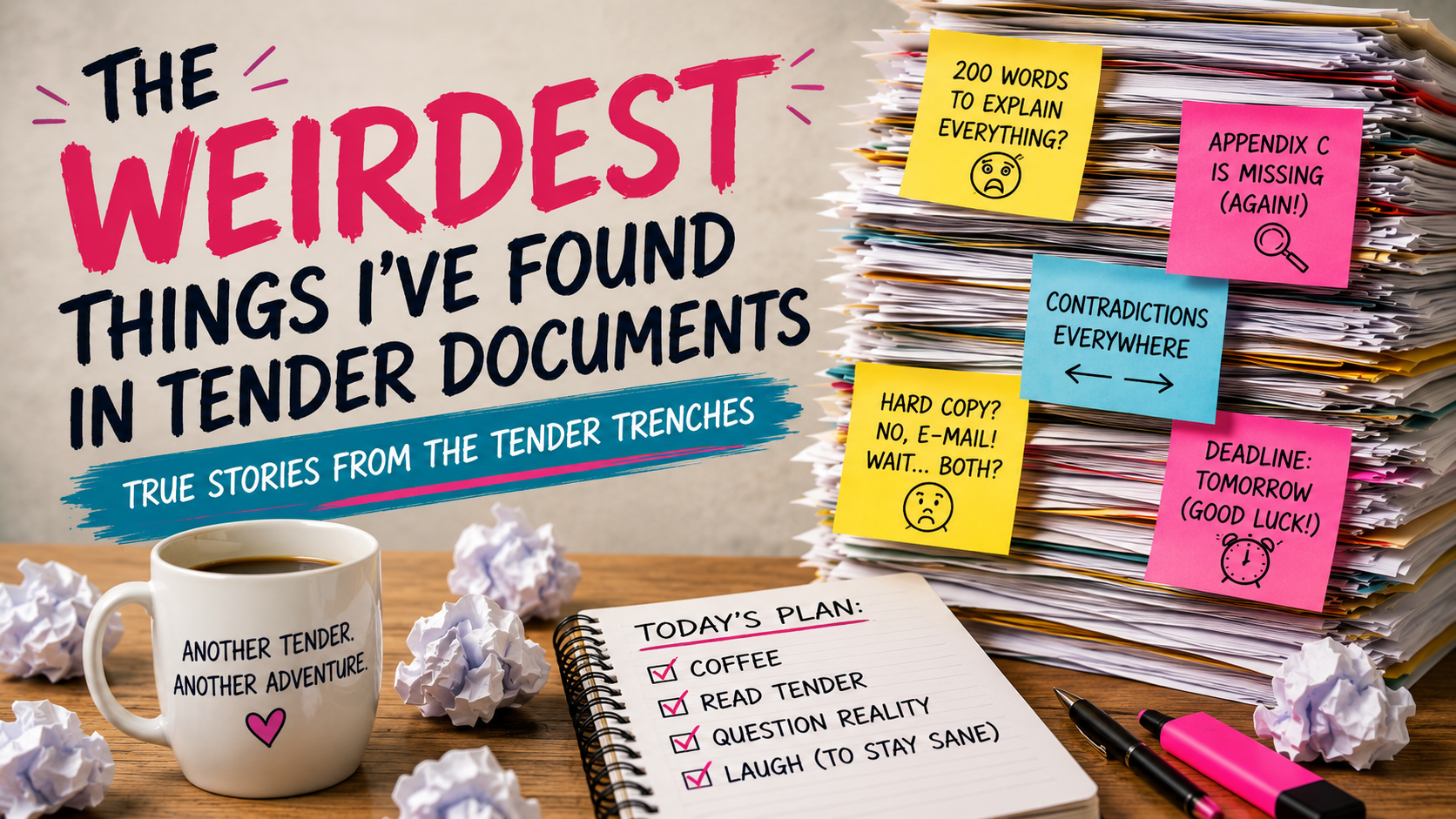
After years of reviewing tenders across almost every industry imaginable, I've collected a mental catalogue of some truly bizarre procurement moments. Here are a few of my favourites.
The Tender that wanted everything in 200 words
Recently, I reviewed a tender where suppliers were asked to demonstrate their technical capability, project methodology, risk management approach, staffing structure, quality systems, environmental controls, innovation strategy, and previous experience.
The word limit? Two hundred words. Not per question. Total.
I've written LinkedIn comments longer than that.
The form that referenced a completely different contract
One tender included several mandatory forms. Halfway through completing them, I noticed the forms referenced an entirely different project in a completely different location. Either someone had copied and pasted the wrong template or we'd accidentally entered a parallel procurement universe.
To their credit, the buyer eventually issued an amendment - after several suppliers pointed it out.
The evaluation criteria that didn't match the scope
Occasionally, I'll see a tender where the evaluation criteria seem disconnected from what is actually being purchased. The scope might focus heavily on service delivery and technical capability. But the evaluation weighting? Sixty percent price, twenty percent compliance and twenty percent everything else.
At that point, suppliers start wondering whether the buyer wants the best solution or simply the cheapest one.
The missing pages mystery
One of my personal favourites involved a tender document that repeatedly referred to information contained in "Appendix C."
There was only one problem. Appendix C didn't exist. I searched. The client searched. Other suppliers searched. Eventually, an addendum was issued containing the missing information (apparently, Appendix C had enjoyed a brief but successful career as an invisible document).
The contradiction championship
Tender documents occasionally manage to contradict themselves with impressive efficiency. One section states that electronic submissions are mandatory. Another states that hard-copy submissions are required.
One page says subcontractors are permitted. Another says subcontractors are prohibited.
One schedule requests three referees. Another requests five.
It's like watching two different authors argue through a document.
The deadline that defied physics
Some procurement teams appear remarkably optimistic about how long complex submissions take to prepare. I've seen requests for detailed methodologies, pricing schedules, implementation plans, personnel resumes, management systems, financial statements, and project programs all due within a matter of days.
Technically possible? Perhaps. Practical? Not so much.r
The clarification that raised more questions
Sometimes suppliers submit a straightforward clarification question. The response should be simple - but instead, the answer somehow creates three entirely new questions.
Everyone involved finishes the process more confused than when they started. It's definitely a special talent!
Why this matters
These examples are amusing, but they highlight something important. Tendering isn't just about suppliers proving their capability. Buyers also need to clearly communicate what they're seeking.
The best procurement processes create clarity, encourage competition, and make it easy for evaluators to identify the strongest solution. The worst create confusion, frustration, and unnecessary risk for everyone involved.
Fortunately, most tenders fall somewhere in the middle. Although every now and then, one arrives that deserves a place in the Tender Document Hall of Fame. And trust me, those are the ones tender writers never forget.
If you have a tender thats frustratung the heck out of you, I’m always happy to talk. You can contact me on 0400 514 579 or shoot me an email to pauline@tenderwise.com.au.
7 tender writing lessons I've learned after reviewing hundreds of submissions
After years of working with businesses across Australia to prepare tender submissions, I've had the opportunity to review hundreds of their earlier bids. Some have been successful. Some haven't.
After years of working with businesses across Australia to prepare tender submissions, I've had the opportunity to review hundreds of their earlier bids. Some have been successful. Some haven't.
And while every tender is different, certain patterns appear again and again. If you're preparing to bid for government or corporate work, here are seven lessons I've learned from reviewing winning and losing submissions.

1. Experience alone doesn't win contracts
One of the most common misconceptions is that years in business automatically translate into tender success. Experience certainly helps, but evaluators want more than a list of projects. They want evidence of how that experience will benefit them. The strongest submissions don't simply list contracts. They explain challenges, solutions and outcomes.
2. Methodology matters more than most businesses realise
Many tender responses focus heavily on company information and not enough on delivery. A strong methodology allows evaluators to understand exactly how the contract will be managed from commencement through to completion. This includes staffing, supervision, scheduling, quality assurance, reporting and continuous improvement processes.
3. Most businesses undersell their systems
I've lost count of the number of times a client has casually mentioned a process or system that turns out to be one of their biggest competitive advantages. Whether it's a workforce management platform, a quality inspection process or a customer communication system, these details matter. Don't assume evaluators know what makes your business different.
4. Compliance is the entry ticket
No matter how capable your organisation is, failing to meet mandatory requirements can end your chances before the evaluation even begins. Compliance doesn't win tenders, but non-compliance can certainly lose them.
5. Value is not the same as price
Many businesses assume the cheapest bid will win. In reality, clients are usually assessing overall value. They are balancing cost, quality, capability, risk and service delivery. A higher-priced submission can still be successful if it clearly demonstrates greater value.
6. Evidence always beats claims
Anyone can claim to provide excellent service. Winning submissions back those claims with examples, testimonials, case studies, performance data and measurable outcomes. The more evidence you provide, the more confidence you create.
7. Evaluators need to picture success
This is perhaps the most important lesson of all. The best submissions help evaluators visualise what working with your business will look like. They explain the journey. They describe the processes. They demonstrate capability. And most importantly, they make the client feel confident that the contract is in safe hands.
A last word from Pauline
Tendering isn't simply about answering questions. It's about reducing risk, building confidence and helping evaluators understand why your business is the right choice.
The good news is that most businesses already have the experience, systems and capability required to win. The challenge is learning how to communicate those strengths effectively. That's where a well-prepared tender response can make all the difference. If you’d like to chat about your tendering experience, I’m always happy to talk. You can contact me on 0400 514 579 or shoot me an email to pauline@tenderwise.com.au.

How to Win a Government Tender for Cleaning Services (it's not just about your experience)
One of the most common things I hear from cleaning companies who contact me after they’ve submitted their own unsuccessful bid is that they don't understand how they lost. After all, they’ve been doing cleaning work well (some may even say exceptionally well) for years. And to be fair, they're often right.
One of the most common things I hear from cleaning companies who contact me after they’ve submitted an unsuccessful bid is that they don't understand how they lost. After all, they’ve been doing cleaning work well (some may even say exceptionally well) for years. And to be fair, they're often right.

That’s because most of the businesses I work with are highly capable operators. They have experienced staff, good systems, loyal clients and a proven track record of delivering quality cleaning services. But they still find themselves missing out on government contracts.
And once I read through their submission, the reason is pretty clear. It’s not their experience, their pricing or even their capability. It's simply the way they tell their story.
A Government cleaning tender isn’t just a test of whether you can clean a building. It’s an assessment of how well you can demonstrate that you understand the client's requirements, have a clear plan for delivering the required services and can consistently achieve the desired outcomes. In other words, it's not just what you've done - it's how effectively you communicate it.
One area where I see cleaning companies consistently undersell themselves is within the methodology section of a tender response.
Many submissions simply repeat the scope of works back to the client. They'll list tasks such as vacuuming, mopping, sanitising amenities and emptying bins, often in exactly the same order they appear in the tender documentation.
The problem with this approach is that the evaluator already knows what they want cleaned. What they want to understand is how you intend to deliver the service.
For example, if you're tendering for a large government office complex, a university campus or a group of public facilities, the panel wants to know how the work will actually flow on a day-to-day basis. So, when you’re developing the response, weave the delivery story through your methodology.
These details that help an evaluator visualise your service delivery model are things like:
Who arrives first?
What time does the cleaning team commence?
How are the buildings divided between staff?
What areas are cleaned daily, weekly or monthly?
How are supervisors involved?
What happens if a staff member calls in sick?
How are quality inspections completed?
What systems are used to monitor performance?
A strong methodology allows the panel to picture exactly how the contract will operate from the first day of commencement.
The most successful cleaning tender responses often include a detailed works schedule that demonstrates this understanding. Rather than simply stating that a building will be cleaned each evening, they clearly explain the process.
For example, Building A may require two cleaners commencing at 5:00 pm, with approximately two and a half hours allocated to office spaces, amenities and common areas. Building B may require a single cleaner commencing at 6:00 pm, with completion expected by 8:30 pm. Weekly deep cleaning activities may be scheduled every Friday evening, while monthly high-level dusting is programmed during quieter operational periods.
By providing this level of detail, the client can immediately see that you have invested time in understanding the site and developing a realistic delivery plan.
Another area that often separates winning submissions from average ones is the explanation of systems and technology. I know many cleaning companies who have invested significantly in works management systems but fail to explain how those systems benefit the client.
Whether you're using CBS, ServiceM8, Simpro, TrackTik or another platform, don't simply mention the software and move on. Explain how it works.
Describe how staff clock on and off at each site. Explain how supervisors monitor attendance in real time. Outline how quality inspections are recorded and how corrective actions are tracked through to completion.
Government clients want confidence that they will receive consistent service delivery and visibility over performance. Demonstrating the practical application of your management systems helps provide that confidence.
I also encourage cleaning companies to focus on outcomes rather than simply listing contracts they've completed. So, rather than just saying that you currently clean ten schools, explain what you achieved. Did you improve inspection scores, reduce complaints, introduce more efficient cleaning schedules and/or improve communication with site management? Include it in the submission so the evaluators want what you can provide for their facilities.
Government evaluators are constantly assessing risk. The more examples you can provide of challenges you've successfully managed, the lower your perceived risk becomes.
One of my favourite ways to strengthen a cleaning tender is by including thoughtful value-added services. This doesn't mean offering expensive extras that erode your profit margin. It means identifying small initiatives that create genuine value for the client.
For example, a cleaning contractor might offer an annual upholstery steam cleaning service at no additional cost during the carpet cleaning periodicals. Another may provide periodic pressure cleaning of external pathways, complimentary consumables audits, additional quarterly deep cleans of high-touch areas, or annual cleaning awareness sessions for site stakeholders.
These types of value adds demonstrate that you're thinking beyond the minimum contractual requirements. And importantly, they also help differentiate your submission from competitors who are simply responding to the specification.
At the end of the day, most cleaning companies competing for government work are capable of delivering the service. Most have trained staff. Most have suitable equipment. Most have relevant experience.
What often determines the winner is the company that makes the evaluator feel most confident. That usually means:
·They clearly explained the cleaning methodology.
They demonstrated exactly how the service will be delivered.
They provided evidence rather than promises.
They told a compelling story about why they are the safest choice.
That's why winning government cleaning tenders is rarely about having the most experience. It's about presenting your experience in a way that allows the client to see the value you will bring from day one.
If you’d like to talk about how to improve your success rate with Government Cleaning Tenders, give me a shout, I’d be happy to chat over the phone or over email. You can contact me on 0400 514 579 or shoot me an email to pauline@tenderwise.com.au.
How to Write a Winning Methodology for your Tender
If there’s one section that consistently separates strong tenders from the ones that miss the mark, it’s the methodology. And it’s also the section most businesses get wrong. I’ve lost count of how many times I’ve seen methodologies that are either too generic, too high-level or just a copy and paste of how you usually do things.
If there’s one section that consistently separates strong tenders from the ones that miss the mark, it’s the methodology. And it’s also the section most businesses get wrong. I’ve lost count of how many times I’ve seen methodologies that are either too generic, too high-level or just a copy and paste of how you usually do things.

Here’s the reality - your methodology isn’t about what you do. It’s about proving how you will deliver this specific contract better than anyone else. So let’s break down how to actually do that.
What evaluators are looking for
Before you write a single word, you need to understand what this section is really assessing. They’re not just asking what your processes are. They want you to demonstrate that you understand the scope, that you’ve thought about the risks and that you can deliver without hand-holding. Are you low risk? Have you done this before (and learned from it)? If your methodology doesn’t address that, it won’t score well.
The biggest mistake that costs you work
Most methodologies look something like this:
Work establishment
Mobilise resources
Complete the project in accordance with specifications
Ensure quality outcomes.
And yeah, It sounds fine (to you). and it reads professionally (kind of). But it tells the evaluator absolutely nothing. There’s no detail. No project-specific thinking. No proof. Your response could apply to literally any job - and that’s exactly why it doesn’t win.
What a winning methodology actually looks like
A strong methodology does three things really well:
It follows the actual delivery journey
Not internal departments and not generic phases. Think:
Pre-start / planning
Mobilisation
Delivery
Quality & compliance
Close-out
It should read like a clear, logical story of how the job will unfold.
It is specific to this contract
This is where many submissions fall down. You should be referencing things like:
Site constraints
Lead times
Stakeholders
Risks
Program pressures
Remember - if you can swap your client’s name out and use it somewhere else, it’s not specific enough.
It uses proof, not just promises
Anyone can say they ensure quality. But a strong response demonstrates how you ensure it, what systems you use, what checks are in place and where you’ve done it before
Real example (before vs a)
Here’s a weak version:
We will deliver the project in accordance with the specifications, ensuring all safety, quality and environmental requirements are met.
And here’s a strong version:
Prior to mobilisation, we will complete a detailed review of all project documentation, including Part 3.3.1 Deliverables and Contractor Performance Targets, to ensure full alignment with scope requirements.
Given the 20-week lead time identified for prefabricated components, early procurement will be initiated immediately upon award, alongside confirmation of supplier production schedules. We will also engage secondary suppliers to mitigate potential delays.
During delivery, all works will be managed through Xero Projects, enabling real-time tracking of progress, cost, and resource allocation. Hold points and inspection checklists will be implemented at key stages, including structural installation and final fit-off, to ensure compliance with specifications and AS standards.
Of course, this is a very simplistic version and you should include alot more detail that is specific to your business and the opportunity but hopefully you get the picture.
The difference is that one is vague - and the other shows understanding, planning, systems and risk awareness. And that’s exactly what evaluators are looking for.
How to structure your methodology so it scores well
Here’s a structure I use across most tenders:
Understanding of the project - brief, but sharp., show that you get it.
Pre-start & planning - include document review, your procurement strategy, risk identification and program development.
Mobilisation - think resource allocation, site setup and stakeholder engagement
Delivery methodology - this is the core, so break it down into actual activities, not generic steps.
Quality assurance - include details of inspections, hold points and systems (ISO, audits, etc.).
Risk management - this doesn’t mean just listing risks, it’s how you actively manage them.
Program & time management - show how you’ll hit deadlines (especially if there are known constraints).
Completion & handover - this bit is often rushed, but still scored.
A quick but important tip
Write it like the evaluator has never met you. Don’t assume they know your systems, your experience, or your processes. Spell it out clearly, but keep it tight because clarity beats complexity every time.
Final thought
A winning methodology isn’t about sounding impressive. It’s about making the evaluator think that you have thought this through, and you know exactly what you’re doing. If you can get that reaction, you’re in a very strong position.
But if you’re not sure whether your methodology is hitting the mark, that’s usually the first place I start with clients - because it’s often the difference between shortlisted and unsuccessful. If you’d like to chat about your tender submissions, just shoot me an email to pauline@tenderwise.com.au or give me a call on 0400 514 579.
What “Value for Money” Really Means in Tender Evaluation
If you’ve ever put your heart and soul into a tender submission, only to lose out to a competitor you know isn’t the cheapest, you’ve probably found yourself asking the same question - something along the lines of “how on earth did they win that?” The answer, more often than not, comes down to one of the most misunderstood phrases in tendering - VALUE FOR MONEY.
If you’ve ever put your heart and soul into a tender submission, only to lose out to a competitor you know isn’t the cheapest, you’ve probably found yourself asking the same question - something along the lines of “how on earth did they win that?” The answer, more often than not, comes down to one of the most misunderstood phrases in tendering - VALUE FOR MONEY.

And here’s the truth - it usually doesn’t mean lowest price. Not even close in most cases (although don’t get me wrong here - price is always important).
It’s not about being the cheapest
Let’s get this out of the way first. Government and corporate buyers are not simply looking for the lowest quote. In fact, awarding a contract purely on price would be considered poor procurement practice in many cases. Instead, evaluators are asking:
Will this supplier deliver what they’ve promised?
Will they do it safely, reliably, and to the required standard?
Are there risks hidden behind that low price?
A submission that comes in significantly cheaper than others can actually raise red flags. It might suggest that corners will be cut, the scope hasn’t been fully understood, or that you may struggle to deliver. So while price absolutely matters, it’s only one piece of a much bigger puzzle.
So… what does value for money mean?
At its core, Value for Money is about getting the best overall outcome, not just the lowest upfront cost. Think of it as a balance between price, quality, risk, capability, and whole-of-life cost Evaluators are weighing up what they are really getting for thieprice offered.
The key factors evaluators look at
Let’s break down what typically sits behind a Value for Money assessment.
Capability and experience - can you actually deliver the work? This is where your track record, case studies, and team experience come into play. A slightly higher price can easily be justified if you’ve demonstrated the proven delivery of similar projects, strong systems and processes, and a team that knows exactly what they’re doing.
Quality of your methodology - this is a big one, and where many tenders are won or lost. Evaluators are looking for a clear, logical approach, evidence that you understand the scope, and practical, well-thought-out delivery methods. If your methodology feels generic or copy-pasted, it weakens your perceived value - no matter how competitive your price is.
Risk (and how you manage it). Every project has risk. The question is, have you thought about it properly? Strong submissions don’t just list risks, they show insight into project-specific challenges, realistic mitigation strategies and confidence in delivery. A higher-priced tender that clearly manages risk can be seen as better value than a cheaper one that ignores it.
Whole-of-life cost. This is where things get interesting, because buyers aren’t just thinking about what something costs today. They’re thinking about maintenance, durability, operational efficiency and future repairs or replacements. For example, a slightly more expensive solution that lasts longer or requires less maintenance may represent far better value over time.
Innovation and added value. This is your chance to stand out, so you should include in your offer things like smarter ways of delivering the work, time or cost efficiencies or environmental and community benefits. These extras don’t always need to be groundbreaking, but they do need to be relevant and practical.
Why great businesses still lose
Here’s the tough part. You can be highly capable, experienced, and competitively priced - but still lose if you don’t clearly articulate your value. Because evaluators can only assess what’s in front of them. If your submission undersells your experience, lacks detail in the methodology, or doesn’t address risk properly - then your value becomes invisible.
How to position yourself as best value
If you want to win more tenders, you need to shift your mindset from “how do we come in cheapest?” to “how do we demonstrate the best overall value?” That means being crystal clear on your strengths and differentiators, tailoring every response to the specific tender requirements, providing evidence, not just claims, and showing evaluators exactly why your price makes sense
Final thoughts
Value for Money isn’t a buzzword - it’s the foundation of how tenders are assessed.And once you understand that it’s about the complete package, everything changes. Because you stop competing purely on price, and start competing on confidence, clarity, and credibility. And that’s where the real wins happen.
Need help positioning your tender as best value?
If you’re not sure whether your submissions are clearly demonstrating value, or you’re tired of missing out despite being a strong operator, it might be time to take a different approach.
At TenderWise, we help businesses turn their experience into compelling, high-scoring tender responses that speak directly to what evaluators are looking for. Because being good at what you do isn’t enough…you need to prove it on paper.
If you need a hand, or you’d like to just have a chat, feel free to reach out. You can call me (Pauline) on 0400 514 579 or shot me an email to pauline@tenderwise.com.au
A quick reality check before you dive headfirst into your next tender
Winning a government tender isn’t just about sitting down at the last minute and writing something that sounds impressive. It’s about being genuinely set up to deliver the work before you even type the first word of your submission. And this is where I see so many good businesses come unstuck.
Winning a government tender isn’t just about sitting down at the last minute and writing something that sounds impressive. It’s about being genuinely set up to deliver the work before you even type the first word of your submission. And this is where I see so many good businesses come unstuck.

The usual formula sounds a bit like this:
1. Your business spots an opportunity that looks like it was made for you.
2. You get understandably excited and dive straight into writing the response, only to hit a wall. Maybe you’re missing key documents, or your case studies are vague. Or it could be that your pricing is all over the place.
3. Cue the stress, the late nights, and a rushed submission that doesn’t quite land the way it should.
The reality is that, tender opportunities tend to reward the businesses that are ready before the opportunity lands in their inbox. So, if you’re thinking about going after government work, or you want to actually improve your win rate, here’s a simple 10-point check to see where you’re really at. And it centres on:
· Your relevant experience.
· How clearly you explain what you do.
· The strength of your case studies.
· Your systems and processes.
· Your understanding of the tender compliance requirements.
· Your pricing (of course).
· Your capacity to deliver.
· Your key documents.
· Understanding the evaluation criteria.
· Making the right go/no-go decision.
1. Have You actually done this kind of work before?
It’s not just about whether you can do the job, it’s about whether you can prove it. Government organisations want confidence, and they’re looking for hard evidence of similar work. This means projects of comparable size, scope, and complexity, with real outcomes demonstrated. And if your experience doesn’t quite line up yet, that’s okay, but you’ll need a clear strategy to bridge the gap. Vague claims won’t cut it. That’s why it’s a good idea to start building a register of your past projects now, even informal ones. You’ll thank yourself later.
2. Can you clearly explain what you do?
This sounds obvious, but it’s easy to get wrong. Tender responses are not the place to figure out your messaging on the fly. You need to be able to confidently say what you do, how you do it, and what makes you different. If your thinking is a bit fuzzy right now, it will come through in your submission. The tender evaluators read hundreds of these, and they’re definitely not looking for unsubstantiated fluff.
3. Do you have strong case studies?
Case studies are genuinely one of your most powerful tools in a tender. This is where you get to clearly demonstrate that you’re the right fit for the job. A great case study takes the reader on a quick journey covering the challenge you were given, what you did about it, and what happened as a result. It should be concrete, specific and measurable where possible. If your examples are vague or generic, you’re leaving a lot of points on the table. My recommendation is that you aim for at least 3 to 5 strong, well-documented case studies across different project types or sectors. Remember, quality beats quantity every time.
4. Are your systems and processes actually documented?
Government entities love consistency, and that comes from having proper systems in place such as deeply entrenched quality, safety and environmental and risk management systems. Ideally, you’ll have an Integrated Management System that ties it all together. But at the very least, you need clear, structured processes you can actually point to, and not just ones that live in someone’s head.
5. Do you understand the compliance requirements?
This is fundamental because insurances, licences, certifications, and policies are all standard requirements in almost every government tender I’ve seen. And if you can’t tick these boxes, your submission might not even get read. Compliance may not be exciting, but it’s the price of entry so get it sorted before you need it.
6. Is your pricing actually realistic?
Winning work at any cost is not a strategy, it’s a fast track to a very bad time. You should have a deep understanding of your true cost base and market expectations and be able to articulate where you add value beyond just being the cheapest option in the room. Price too high and you’re out of the running. Price too low and you might win, but the cost of that win could be ruinous for your business. And no one wants to be in a race to the bottom.
7. Do you genuinely have the capacity to deliver?
This is the true crux of everything. Do you have the people, the equipment, and the systems ready to go right now? If not, can you demonstrate the skills and experience of the key team who will be responsible for the contract outcomes, and can you demonstrate your recruitment, induction and training processes to ensure you employ the right people to deliver? If you’re going to be recruiting, this is a good time to include Position Descriptions for those staff, or at the very least, provide a list of responsibilities and reporting lines.
8. Are your key documents ready to go?
Strong submissions rely on having everything ready at your fingertips, including capability statements, key staff resumes, policies, certifications, and details of any industry memberships. If you’re scrambling to pull these together at the last minute, it shows. And not in a good way. Rushed documents look exactly that way.
9. Do you understand how you’ll actually be evaluated?
Not all tenders are scored the same way. Some are heavily weighted toward price, while others focus on your methodology, your experience, or how you manage risk. And some have mandatory criteria that mean instant disqualification if you don’t meet them. If you don’t understand what the client is really looking for, you can’t tailor your response to score well. And that’s where a lot of submissions fall down. Because they answer the questions, but not in a way that resonates with evaluators.
10. Do you have a go/no-go process?
Just because a tender exists doesn’t mean you should go for it (in fact, I sometimes tell my clients not to proceed if I feel a particular opportunity isn’t right for them). Before you commit, make sure you are actually competitive, meet the key criteria, and that the opportunity is worth the time and resource investment. A simple go/no-go process can save you from chasing the wrong opportunities and free you up to focus on the ones where you actually have a real shot.
So — are you tender-ready?
If you’ve read through this and you’re feeling pretty solid across most of these points, that’s genuinely great. You’re in a strong position. But if a few of these have given you pause, there’s no need to stress. Tender readiness isn’t about being perfect. It’s about knowing where your gaps are and working on them before the pressure is on. Because when the right opportunity comes along, you don’t want to be scrambling. You want to be ready.
One more thing: the hidden cost of being unprepared
Here’s something that doesn’t get talked about enough: the cost of a failed tender isn’t just the submission itself. It’s the hours your team spent on it. The opportunity cost of not pursuing better-fit work. The dent in morale when you put in real effort and don’t get the outcome. In my experience, the businesses that approach tendering strategically (knowing when to go, when to say no, and how to position yourself properly) consistently outperform those that treat it as a reactive exercise.
The preparation you do now isn’t wasted effort. It’s an investment in every single opportunity that comes your way down the track.
I’ve written hundreds of tender responses and I know that the businesses who consistently win tenders aren’t always the biggest or the cheapest. They’re the ones who are prepared, strategic, and deliberate in how they approach the process. And that preparation starts long before the tender is released. If you want a hand getting there TenderWise is always here to help. And a chat genuinely costs you nothing.
Why I sometimes tell my clients NOT to proceed with a tender
It might sound strange coming from someone who makes a living helping businesses win tenders… but sometimes, the best advice I can give a client is simply “don’t go for this one.”
Not let’s give it a crack, or we’ll see how we go. Just very clear advice that this isn’t the right opportunity for them. And no, it’s not because I don’t want the work. It’s actually the opposite.
It might sound strange coming from someone who makes a living helping businesses win tenders… but sometimes, the best advice I can give a client is simply “don’t go for this one.”
Not let’s give it a crack, or we’ll see how we go. Just very clear advice that this isn’t the right opportunity for them. And no, it’s not because I don’t want the work. It’s actually the opposite.
Because I care about my clients’ time, money, and energy, and I’ve seen too many great businesses burn all three chasing the wrong opportunities.

On the surface, a tender can look perfect.
The scope aligns with what you do.
The contract value is attractive.
It’s a government client (which always feels like a win).
But when you dig deeper, things can start to unravel quickly. Maybe the requirements are heavily weighted toward prior experience you don’t yet have. Maybe the incumbent has been in place for 10 years and is deeply embedded. Maybe the pricing expectations are unrealistic. Or maybe the contract terms carry more risk than reward.
These are the things you don’t always see at first glance - but they matter. A lot.
There’s a common mindset in business along the lines of “we may as well submit - you never know.”
And I get it. I really do. But here’s the reality - tenders aren’t quick, easy or low-effort. A proper submission takes:
Days of your time.
Input from key people across your business.
Careful thought, strategy, and positioning.
And usually, a financial investment if you’re engaging support.
So when you decide to “just have a go,” what you’re really doing is diverting resources away from your business – and sometimes with a very low probability of success. And that’s the part most people underestimate.
Red flags I look for
When I review a tender, I’m not just looking at whether you can do the work. I’m trying to establish if you are genuinely competitive here. Some of the biggest red flags include:
You don’t meet key mandatory criteria. This is the big one. If you can’t tick the non-negotiables, it doesn’t matter how good the rest of your submission is.
You’re trying to “stretch” your experience. There’s a BIG difference between positioning your experience well and trying to make something fit when it doesn’t. Evaluators will see through that very quickly.
The weighting doesn’t favour you. If 40–50% of the score is based on something you’re weak in (like large-scale government experience or niche capability), you’re already on the back foot.
Unrealistic pricing pressure. If the market is saturated or the client is clearly cost-driven, you may find yourself competing in a race to the bottom. That’s rarely where you want to be.
The incumbent advantage is strong (and deeply entrenched). It’s not impossible to overcome, but it needs to be acknowledged. Sometimes you’re not just competing, you’re trying to displace a well-performing, well-liked provider. That’s a very different strategy.
It’s not a “no” - it’s a “not this one”
When I recommend not proceeding, it’s never about shutting the door. It’s about being strategic.
Because the businesses that win consistently aren’t the ones chasing everything, They’re the ones choosing carefully where they invest their effort. Instead of spending time on a low-probability tender, we can:
Strengthen your capability statements.
Build better case studies.
Prepare for upcoming opportunities.
Position you more strongly for the right tenders.
In other words, we focus on winning - not just participating.
Tendering isn’t about one submission. It’s about building credibility, capability, and a track record over time. And sometimes that means saying no today - so you can say yes to a much better opportunity in three months. Or six. Or twelve.
And when that right opportunity comes along - one where you’re aligned, competitive, and well-positioned - everything changes.
Your submission is stronger.
Your confidence is higher.
And your chances of winning are significantly better.
I know it can be disappointing to hear that a tender isn’t worth pursuing, especially when you’ve already started thinking about the opportunity. But my role isn’t just to write submissions. It’s to give you honest, commercial advice that helps you grow your business. Even when that advice is “let this one go.”
Because in tendering (just like in business) what you don’t do is often just as important as what you do.
If you’d like to chat about the strategic fit for a tender that’s just been released, I’m always happy to chat. Just give me a call on 0400 514 579 or email pauline@tenderwise.com.au.
Tender Opportunities - Should we Work with a Tender Writer or DIY?
When a new tender opportunity lands in your inbox, one of the first questions most businesses ask is:“Should we write this ourselves, or bring in a professional?” It’s a fair question—and the answer isn’t always straightforward.
When a new tender opportunity lands in your inbox, one of the first questions most businesses ask is: “Should we write this ourselves, or bring in a professional?” It’s a fair question - and the answer isn’t always straightforward.
In this article, we break down the real costs, risks, and potential outcomes of both options so you can make the right decision for your business. The focus is on how to win Government tenders.

The Reality: Tendering Is More Competitive Than Ever
Government and large-scale tenders are no longer just about capability - they’re about how well you communicate your value. In most cases:
You’re competing against experienced bidders.
Submissions are scored against strict evaluation criteria.
Small differences in wording can mean large differences in scoring.
The result? Strong businesses lose tenders - not because they lack capability, but because they don’t present it effectively.
Option 1: Writing the Tender Yourself
Many businesses choose to prepare their own submissions - especially when starting out.
Pros:
No upfront cost.
Full control over content.
Deep internal knowledge of your operations.
Cons:
Time-consuming (often 40–100+ hours).
Difficult to align with evaluation criteria.
Risk of missing compliance requirements.
Hard to objectively “sell” your own business.
The biggest risk: You know your business too well - so you may assume things instead of clearly articulating them.
Option 2: Working with a Professional Tender Writer
A professional tender writer Australia brings structure, strategy, and an external perspective.
Pros:
Aligns responses directly to evaluation criteria.
Improves clarity, structure, and scoring potential.
Identifies gaps before submission.
Saves significant internal time.
Cons:
Upfront cost.
Requires collaboration and input from your team.
The biggest advantage: A good tender writer doesn’t just write -they translate your experience into what evaluators are actually looking for.
What Does It Cost?
Tender writing fees in Australia can vary depending on complexity, but generally:
Small tenders: $2,000 – $5,000
Medium tenders: $5,000 – $10,000
Large/complex tenders: $10,000+
While this may seem like a significant investment, it needs to be viewed in context:
If the contract value is $500,000+ (or multi-year), the cost of losing is far greater than the cost of getting it right.
Cost vs Win Rate: The Real Equation
The key question is not just: “What does it cost?”
It’s: “What are my chances of winning if I don’t invest in this?”
When Should You Hire a Tender Writer?
You should strongly consider professional support if:
The contract value is significant.
You are tendering for government work for the first time.
The submission is highly detailed or weighted heavily on methodology.
You have limited internal resources or time.
You’ve submitted tenders before but haven’t been successful.
When It Might Make Sense to DIY
Writing your own tender can work if:
It’s a low-value or low-risk opportunity.
You have prior tender experience.
The submission requirements are simple.
You have time to properly structure and review your response.
The Hybrid Approach (Often the Best Option)
Many successful businesses take a blended approach, where:
Internal teams provide technical content.
A tender specialist structures, refines, and aligns responses.
This gives you the best of both worlds:
Authentic content
Professional polish and strategy
Final Thoughts
Tendering is not just a compliance exercise - it’s a competitive process where presentation matters. You might be the best provider on paper…..but if your submission doesn’t clearly demonstrate that, you may never get the opportunity to prove it. This is where tender writing services in Australia can add value.
Not Sure If You’re Tender-Ready?
Before you commit time or money to your next submission, it’s worth asking:
Do we have the right documents in place?
Can we clearly articulate our methodology?
Are we aligned with what evaluators are looking for?
If you’re unsure, a quick review can make all the difference.
Need Support With Your Next Tender?
At TenderWise, we help businesses across Australia prepare high-quality, compliant, and competitive tender submissions. If you’d like support - or even just a second opinion - feel free to get in touch. Cotact Pauline on 0400 514 579 or pauline@tenderwise.com.au.
How to Win an Electrical Tender - a Practical Guide for Contractors
Securing electrical tenders can be the key to sustainable business growth for contractors and service providers. Whether you’re a small local electrician looking to expand into government work or a national player targeting multi-million-dollar contracts, winning a tender requires more than just competitive pricing. It demands strategy, compliance, clear communication, and a solid demonstration of capability.
Securing electrical tenders can be the key to sustainable business growth for contractors and service providers. Whether you’re a small local electrician looking to expand into government work or a national player targeting multi-million-dollar contracts, winning a tender requires more than just competitive pricing. It demands strategy, compliance, clear communication, and a solid demonstration of capability.

In this blog, I’m breakiing down how to win an electrical tender, step by step - from identifying the right opportunities to submitting a winning response.
Know Where to Look
Before you can win a tender, you need to find it. In Australia, electrical tenders are commonly released through:
Government procurement portals such as AusTender, Tenders VIC, and state-specific platforms.
Local government websites – Councils regularly release maintenance, upgrade, and infrastructure-related tenders.
Private sector opportunities listed on platforms like EstimateOne and TenderLink.
You can find out more in this blog. Tip: Sign up for alerts and create profiles on key portals to ensure you’re notified when relevant tenders are published.
Understand the Requirements
Never skim a tender document. One of the most common reasons electrical contractors are disqualified is due to non-compliance with mandatory requirements.
Make sure you have a good understanding of:
The scope of works – what exactly needs to be delivered?
The mandatory criteria - licences, accreditations, or insurances.
The response format - Is there a specific template or structure to follow?
The evaluation criteria –-how will your tender be scored?
The deadline and lodgement process - late submissions are automatically excluded.
Tip: If there’s a briefing session (online or in-person), always attend. It’s often your only chance to ask clarifying questions directly.
Demonstrate Technical Competence
You need to show that you have the technical skills, workforce, and capacity to deliver the job. This is where many smaller businesses fall short - not due to a lack of experience, but because they don’t clearly explain it. Always include:
Details of past similar projects - mention clients, scope, outcomes, and value.
Key personnel - provide bios or CVs of electricians and supervisors.
Certifications and licences - electrical contractor licence, CEC accreditation (if relevant), ISO certifications, etc.
Specialist capabilities –- if you offer energy efficiency audits, hazardous area works, or data cabling, highlight this.
Tip: Use project case studies to bring your experience to life and align it with the tender scope.
Provide a Clear and Competitive Price
While price is important, tenders aren’t just about being the cheapest. You must demonstrate value, so it’s important to provide a transparent pricing structure that:
Breaks down materials, labour, and other costs
Accounts for GST and contingencies
Aligns with the deliverables in the scope
Also, explain how you will manage cost control throughout the project. Demonstrating strong cost management practices builds trust, particularly in government tenders where public money is involved.
Showcase Your WHS and Compliance Systems
Workplace health and safety (WHS) is non-negotiable in tenders, particularly for public infrastructure and institutional clients. Many tenders will want to see:
Your WHS policy and management system
Risk assessment and safe work procedures
Training records or induction processes
Insurance certificates (e.g., workers compensation, public liability)
You may also be asked for evidence of:
Quality management systems
Environmental management practices
Industrial relations history
Tip: Even if you're a smaller operator, having a documented system for safety, environmental and quality management - even if it's not certified to ISO - will boost your credibility.
Support Local and Social Procurement Objectives
Increasingly, Australian tenders - especially government ones - look for suppliers who can demonstrate:
Local economic impact (e.g., use of local suppliers, employing local electricians)
Support for Indigenous businesses or apprenticeships
Sustainable and ethical supply chains (e.g., no modern slavery)
If your business aligns with these goals, say so — and back it up with examples.
Write Clearly and Professionally
A technically skilled electrician might be great on the tools, but if your tender is poorly written, difficult to read, or littered with errors, it could cost you the job. Keep in mind:
Use headings, bullet points, and plain language
Answer every question in the order asked
Avoid waffle - keep it clear and concise
Tailor every response to the specific tender, not a generic template
Tip: Have someone else proofread your tender or hire a professional tender writer if needed.
Build a Bank of Reusable Content
Once you’ve prepared one good tender, you’ll find that much of the content, such as capability statements, staff profiles, policies , can be reused or adapted.
That’s why I always recommend maintaining a library of:
Project case studies
CVs and licences
WHS, environmental and quality policies
Insurance and compliance certificates
This will significantly reduce the time it takes to respond to future tenders.
Submit On Time and In Full
Missing a deadline - even by one minute - will disqualify your bid. So will forgetting to include mandatory forms or attachments.
Create a checklist of:
Required schedules and attachments
Declarations and signed forms
Pricing sheets or BoQs
Electronic submission details (file formats, portal login, etc.)
Aim to submit at least 24 hours before the deadline to allow for any technical hiccups.
Ask for Feedback to Keep Improving
If you’re unsuccessful, always request feedback. Some agencies will provide detailed scoring and commentary, while others may only offer general advice. Use this feedback to:
Refine your pricing
Improve how you describe your capability
Strengthen your compliance systems
Each submission builds your experience and gives you a better chance next time.
Final Thoughts
Winning an electrical tender isn’t just about being the cheapest - it’s about demonstrating reliability, safety, experience, and value. With the right preparation and a professional, well-structured submission, your business can open the door to lucrative and long-term work.
Whether you’re bidding for a local council maintenance contract or a large infrastructure upgrade, follow these steps - and don’t be afraid to seek help from tender professionals if you need support.
Need Help Writing your Tender?
At TenderWise, we help electrical contractors across the country craft compelling, compliant tender submissions that get results. Reach out to Pauline on 0400 514 579 today to see how we can support your next bid.
Happy tendering!
Pauline