

Capability Statement Development
Show People What Your Business Is Capable Of
Someone asks you to send through your Capability Statement.
Easy.
Except now you're staring at a blank document wondering how you're supposed to explain an entire business in eight or ten pages without producing either a glorified company brochure or War and Peace: The Corporate Edition.
A good Capability Statement sits somewhere very comfortably in between.
It gives prospective clients a clear, professional snapshot of who you are, what you do, the experience behind your business and the capability you bring to future opportunities.
TenderWise develops Capability Statements for Australian businesses that are clear, credible and distinctly theirs - combining strong content with professional presentation to showcase the things that genuinely matter.
A Capability Statement Isn't Just an About Us Document
This is probably the biggest misconception. A Capability Statement shouldn't simply tell someone:
When your company started
Where you're located
What services you provide;
That you're committed to quality, safety and customer satisfaction.
All useful information.
But none of it necessarily answers the question your prospective client is really asking:
Why should I consider this business?
That's where the interesting stuff begins.
Your Capability Statement should help them understand your experience, people, systems, resources, project history, strengths and the way you deliver.
It's not just about introducing your business.
It's about demonstrating its capability.
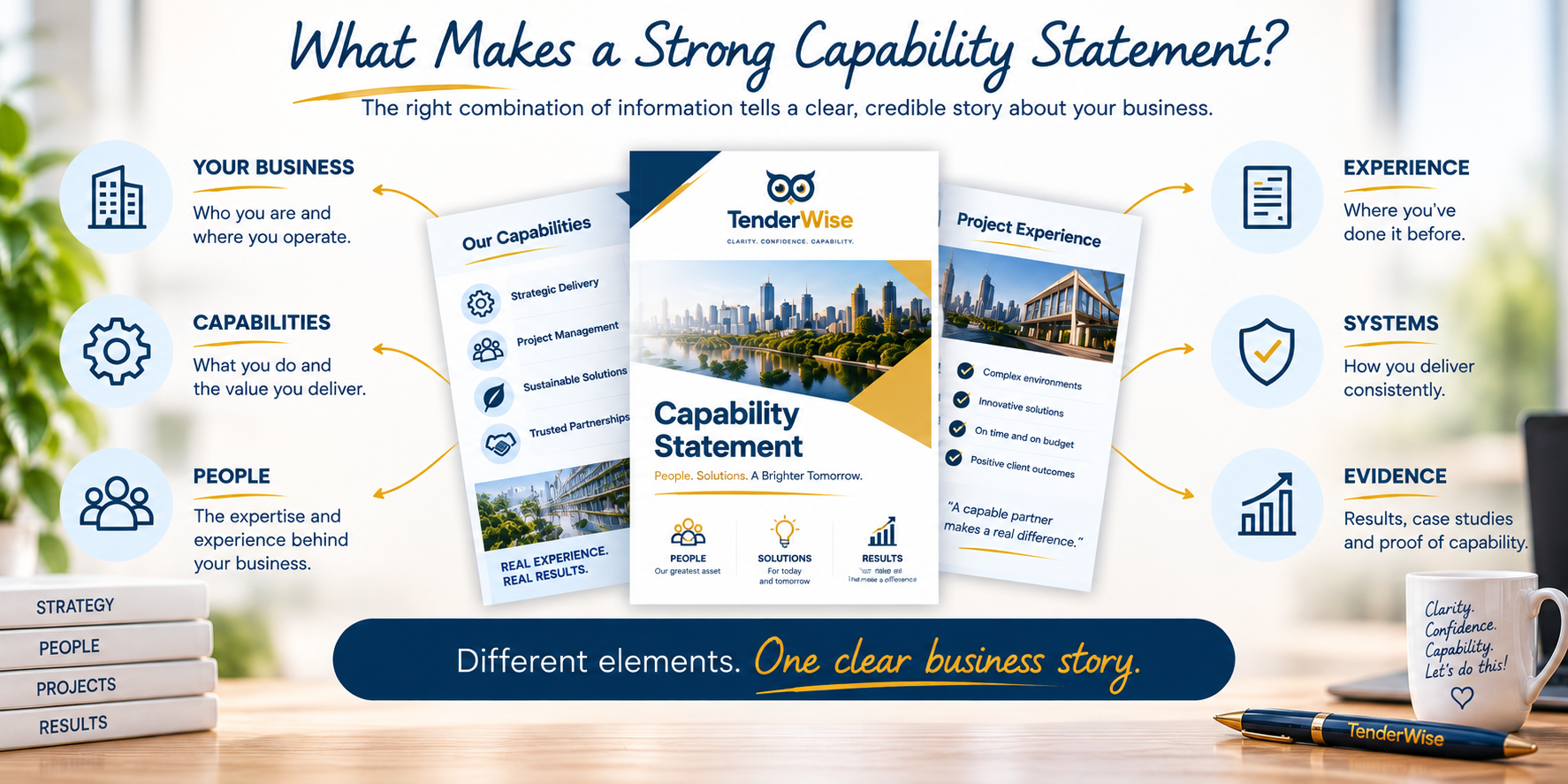
What Goes Into a Capability Statement?
There isn't one perfect structure.
A construction contractor shouldn't have exactly the same Capability Statement as a security company, professional services firm or waste and recycling business.
The document needs to reflect your business, your market and the clients you're trying to reach.
Depending on what's relevant, your Capability Statement might include:
Company Overview
Who you are, where you operate and the story behind the business.
Core Capabilities
The services, solutions or specialist expertise you provide.
Experience
The industries, clients, contracts and environments in which you've worked.
Project Case Studies
Real examples showing what you've delivered, how you've approached it and the outcomes achieved.
People
Key personnel, qualifications, experience and the expertise behind the organisation.
Systems & Accreditations
Quality, WHS, environmental and other management systems, licences, certifications and prequalifications.
Resources & Capacity
Workforce, facilities, plant, equipment, technology, geographic coverage or other resources relevant to your service.
What Makes You Different
The things your business genuinely does particularly well — supported by evidence rather than marketing adjectives.
Clients & Referees
Relevant organisations you've worked with and, where appropriate, people who can speak about your performance.
Contact Details
Because after doing all that work convincing someone you're worth talking to, making them hunt for your phone number would be rather unfortunate.
The Hardest Question Is Usually: What Makes You Different?
This one comes up constantly. And the first answer is often:
“Honestly, I'm not sure. We probably do the same thing as everyone else.”
Usually, you don't.
The difference may not be some revolutionary product nobody else in Australia can provide. It might be how you operate. How quickly you respond. How experienced your people are. The systems you've developed. The way you communicate with clients. How you manage problems. The range of services you can deliver internally. The continuity you provide. A specialist capability. An unusual combination of experience.
Or simply a very good way of doing something that you've stopped noticing because it's completely normal inside your business.
This is why I don't expect you to hand me a list headed OUR AMAZING DIFFERENTIATORS.
I'll ask questions.
We'll find them.
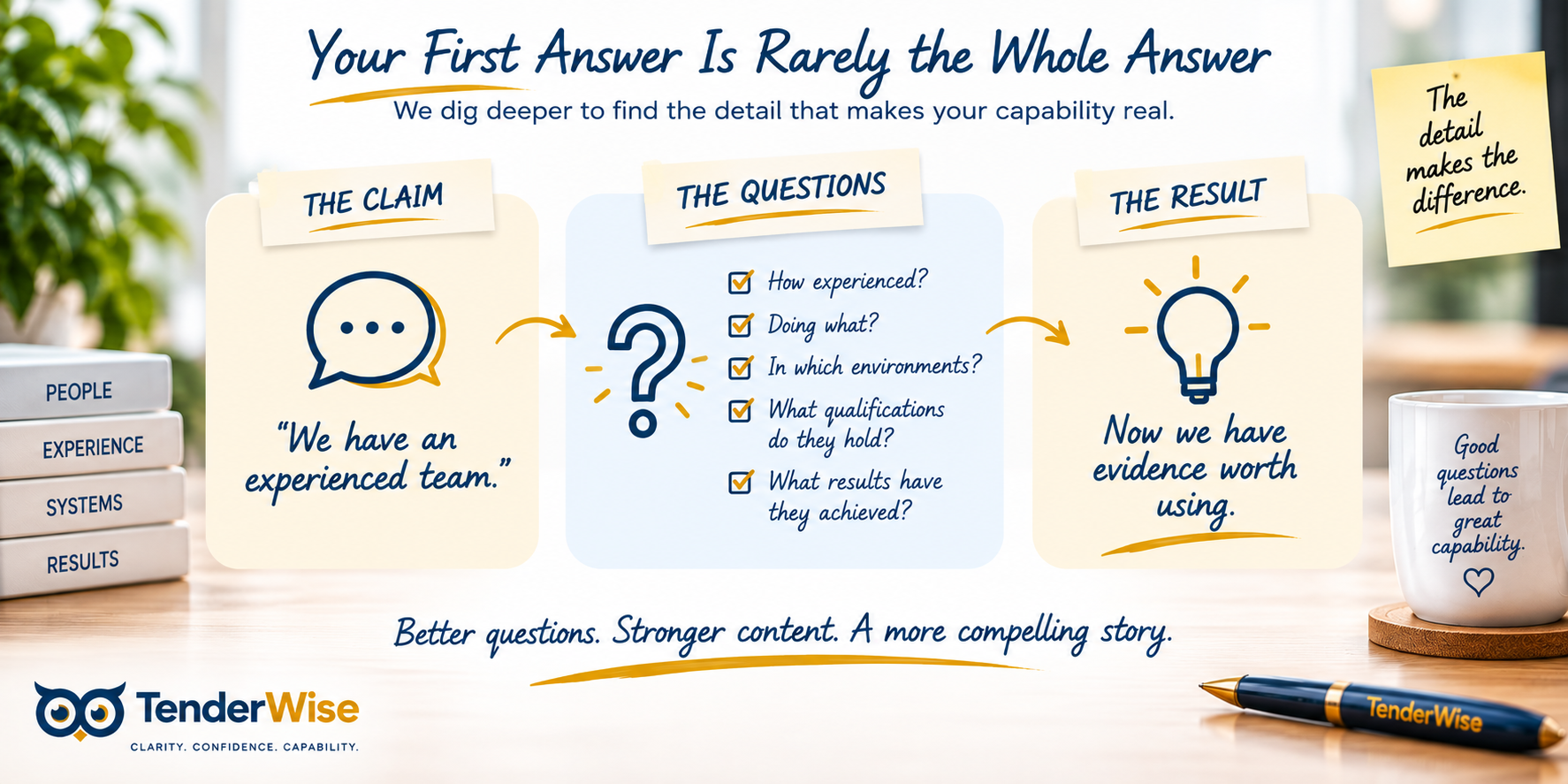
Your First Answer Is Rarely the Whole Answer
If you've spent any time on my website, you may have noticed something of a theme developing here.
I ask questions. Lots of them.
Tell me you have an experienced team and I'll want to know:
How experienced?
Tell me you provide exceptional service:
What does that look like in practice?
Tell me you've delivered hundreds of projects:
Which ones best demonstrate the capability we're trying to showcase?
Tell me you've got great systems:
Which systems? What do they actually help you do better?
That's how we get past generic claims and find the substance that makes the Capability Statement worth reading.
You know your business. My job is to help you see which parts of it your prospective clients need to know about.
Your Project Experience Is Some of Your Best Evidence
One of the most valuable parts of a Capability Statement can be the work you've already done.
Not just a page containing twelve client logos. Actual examples.
A well-developed project case study can show the reader:
The scale and complexity of work you've delivered
The environments you've operated in
The problems you've solved
The systems and people you've relied on
The results you've achieved
The experience you can bring to their opportunity.
We don't necessarily need to include everything you've ever done - because relevant always beats exhaustive.
A handful of well-chosen examples can tell the reader considerably more than an enormous project list.
What If You Don't Have Big-Name Clients?
That's okay. A Capability Statement isn't a competition to see who can squeeze the most impressive logos onto a page.
The value of your experience comes from what it demonstrates.
A smaller project may provide excellent evidence of technical expertise.
A long-standing commercial client may demonstrate reliability and client retention.
A difficult project may show problem-solving and adaptability.
A rapidly delivered project may demonstrate mobilisation and capacity.
A specialist job may demonstrate expertise that very few competitors have.
And if you're a relatively young business, we may also be able to draw appropriately on the experience of your key people — clearly distinguishing their previous experience from contracts delivered by the company itself.
We work with the experience you genuinely have and explain why it matters.
Written for the Clients You Want to Work With
A Capability Statement should have a purpose.
If your goal is to pursue government contracts, we'll think about the information government buyers and larger contractors are likely to want to understand about your business.
If you're approaching commercial clients, we'll consider what matters in that market.
If you're trying to get onto supplier panels or subcontractor databases, we'll make sure the document gives procurement teams a useful overview of your capability.
If you're expanding into a new market, we'll think carefully about which parts of your existing experience transfer.
The aim isn't to make your business appear to be something it isn't.
It's to present the strongest, most relevant version of what it genuinely is.
Designed to Be Read
Content matters enormously. So does presentation.
Most Capability Statements I develop are digital documents, often around eight to ten pages, although the right length depends entirely on the business and the amount of useful information we have to communicate.
The design should help the reader find information quickly rather than burying it under decoration.
That means using things such as:
Clear headings and hierarchy
Short, readable sections
Project imagery
Tables and callouts where useful
Icons and graphics that communicate something
Case-study panels
Key facts and capability highlights
Plenty of breathing room.
I want it to look professional. But I also want someone to actually read it.
It’s More Than Something Pretty to Email
A good Capability Statement becomes a useful business-development asset.
You can use it when:
A prospective client asks for information about your business
Approaching a new customer
Responding to an expression of interest
Registering for supplier or contractor panels
Meeting with potential partners or head contractors
Introducing your business to procurement teams
Supporting a tender submission
Following up a conversation about a future opportunity.
It gives you something considerably better to send than:
“Hi Bob, here's our website. Give me a call if you need anything.”
Although Bob is, of course, still welcome to call.
Capability Statements and Tenders Work Beautifully Together
This is where the value can multiply. The work we do developing your Capability Statement often gives us excellent source material for future tenders - because we've already explored:
Your company history
Your services
Your key people
Your project experience
Your systems
Your resources
Your differentiators;
The evidence behind your capability.
So when a tender arrives, we're not beginning with a blank page.
Likewise, if I've already developed tenders for your business, we may have a considerable amount of good information that can be refined and repurposed into your Capability Statement.
Different document. Same underlying business story.
Already Have a Capability Statement?
You don't necessarily need to throw it away and start again.
If your existing Capability Statement is outdated, too long, too generic or simply no longer represents the business you've become, I can review it and work with what's worth keeping.
Sometimes the design needs refreshing.
Sometimes the content needs restructuring.
Sometimes you've added new services, people, systems or projects and the document has never caught up.
And sometimes it was written years ago and still proudly announces that your fax number is available on request.
We'll work out what stays, what goes and what's missing.
Starting From Scratch?
Also completely fine.
You don't need to write the content before you come to me.
That's rather the point of hiring a writer.
I'll gather the information I need from you, review whatever existing material is useful and ask the questions that help uncover the detail.
That might include your website, previous tenders, project lists, resumes, policies, licences, certifications, client information, photographs or existing marketing material.
Then I'll bring it together into a coherent document that actually sounds like one business telling one story.
Same Business. Stronger Story.
Your business already has capability - the Capability Statement doesn't create it. But what it does is make that capability visible.
Your people.
Your experience.
Your projects.
Your systems.
Your resources.
Your results.
And all those little things you do every day that you've stopped thinking of as particularly remarkable. Put together properly, they tell prospective clients something important:
This is who we are. This is what we've done. And this is what we're capable of doing for you.
Ready to Showcase Your Capability?
Whether you're starting from scratch, refreshing an existing document or preparing to approach a new market, send me what you've got.
We'll work out what your prospective clients need to know, uncover the evidence behind your capability and turn it into a professional document you're genuinely happy to put in front of them.
No generic corporate brochure - and definitely no pages of impressive-sounding fluff.
Just a clear, credible representation of your business and what it can do.
Clarity. Confidence. Capability. Let's do this!