

Tasmania Tenders
Tender Writing for Tasmanian Businesses
Tasmania may be Australia's smallest state, but that doesn't make its tenders simple.
Government agencies, councils, utilities, infrastructure organisations and commercial buyers still want confidence that the business they appoint has the people, systems, experience and capacity to deliver.
And in Tasmania, there can be another important part of the story:
What does your business contribute locally?
Local employment. Local suppliers. Tasmanian subcontractors. Skills development. Regional capability. Investment in the community.
These aren't necessarily things businesses think of as "tender evidence".
Often, they're simply part of how the business operates.
TenderWise helps uncover that evidence and turn it into a clear, credible submission.
Local knowledge. Proven capability. Now let's put it on the page.
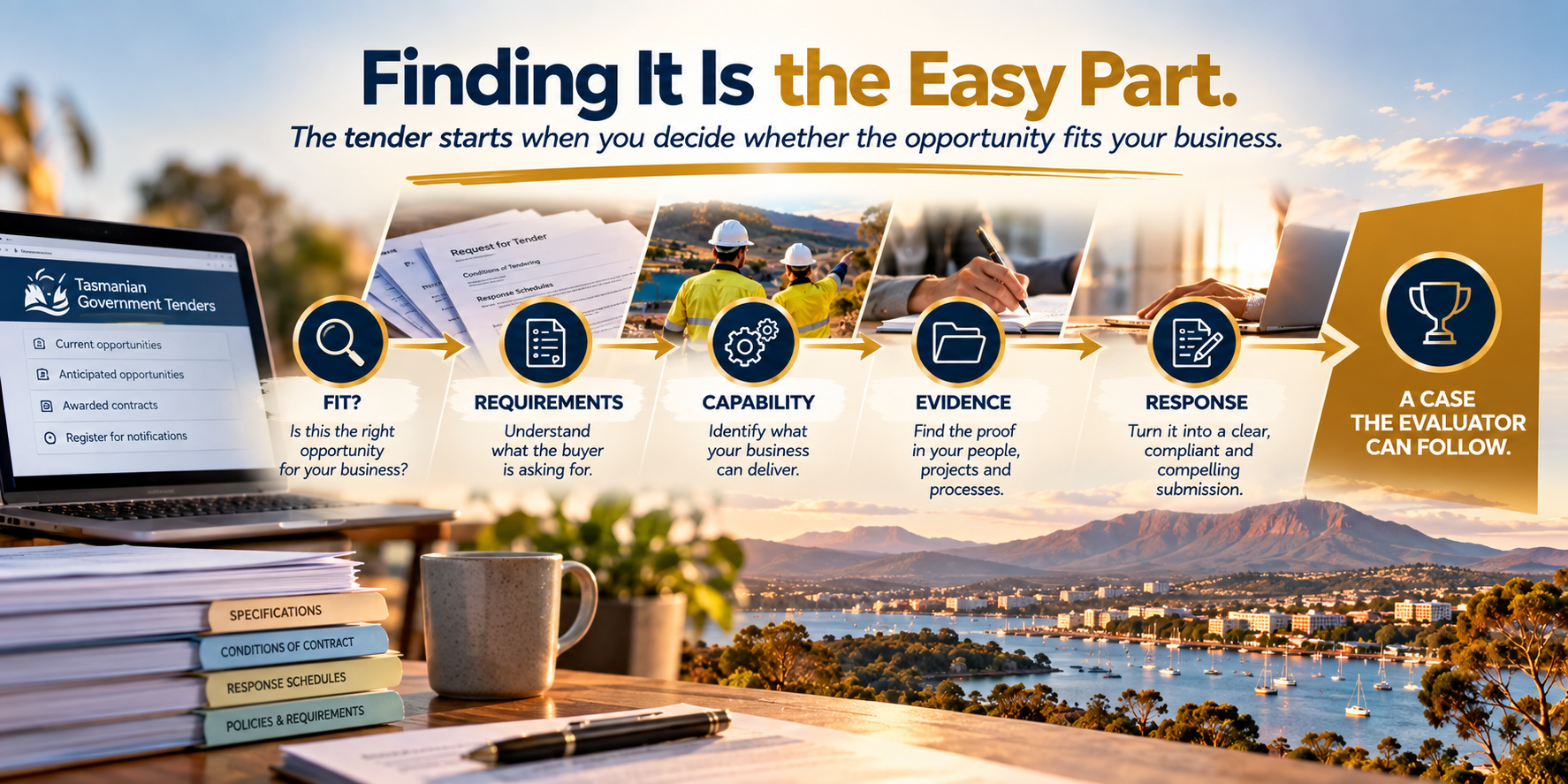
Finding Tender Opportunities in Tasmania
The Tasmanian Government Tenders website publishes current and anticipated State Government procurement opportunities as well as awarded contracts. Businesses can register for notifications and, where enabled by the agency, lodge responses electronically.
Opportunities can also come through:
Local councils.
Government Business Enterprises and State-owned companies.
Utilities.
Infrastructure projects.
Universities and other public organisations.
Major contractors and supply chains.
Commercial organisations.
Business Tasmania also publishes a weekly tender opportunities update drawing together opportunities from TasGov Tenders, AusGov Tenders and Gateway by ICN.
So finding opportunities isn't necessarily the hard part.
Working out which ones genuinely suit your business - and then making a convincing case - is where things get interesting.
Local Economic and Social Benefits Matter
The Tasmanian Government's Buy Local Policy puts significant emphasis on the economic and social benefits generated by government procurement.
For agency procurements, the Economic and Social Benefits criterion has a minimum weighting of 30%. The policy also contains measures designed to give Tasmanian businesses opportunities to compete for government work.
That's substantial.
It means a response about economic and social benefits shouldn't be treated as the fluffy question you complete after you've finished the "important" parts of the tender.
It can be one of the important parts.
Depending on the opportunity, useful evidence might include:
Tasmanian employees.
Local apprentices and trainees.
Tasmanian suppliers.
Local subcontractors.
Regional expenditure.
Skills development.
Employment opportunities.
Community involvement.
Investment in equipment, facilities or capability.
Opportunities for Tasmanian SMEs.
And once again, specifics beat adjectives.
"We strongly support the Tasmanian economy" doesn't tell an evaluator very much.
Showing where your people live, who you buy from, which businesses you subcontract to, what you spend locally and how the contract will create further opportunities does.
Commitments can become Contract Deliverables
Tasmania refreshed parts of its procurement framework from 16 April 2026. Among the changes was an Economic and Social Benefits Schedule of Deliverables, which may be incorporated into contracts to capture commitments made by the successful supplier in its Economic and Social Benefits Statement.
In other words:
Be careful what you promise.
A tender isn't the place to invent an impressive initiative because it might score well.
If you commit to employing people, using particular suppliers, providing training or delivering other benefits, the safest approach is to assume you'll be expected to do exactly that.
That's not a reason to undersell your business.
It's a reason to make the response specific, realistic and evidence-based.

Tasmanian Industry Participation Plans
Some procurements may also require a Tasmanian Industry Participation Plan - or TIPP.
TIPPs are intended to improve opportunities for local SMEs in government-funded or resourced projects. Agencies require them for procurement over specified thresholds and can also require one at their discretion.
A strong participation plan needs more than a statement that you'll "buy local where possible".
Think about what your delivery model actually creates.
Who supplies your materials?
Who services your vehicles or equipment?
Which subcontractors do you use?
Where do you recruit?
What work stays in Tasmania?
Could the contract create new employment or training?
Could a Tasmanian SME become part of your supply chain?
The useful information is often already sitting inside the business.
We just need to find it.
Capability still has to Stack up
Local participation doesn't replace capability.
The buyer still needs confidence that you can deliver what you're offering.
Tasmanian Government guidance identifies factors such as financial viability, qualifications, referee reports, past performance, management systems and controls over subcontracting among the matters that may be considered. Value for money is also broader than simply selecting the lowest price.
Depending on the tender, that can mean demonstrating:
Relevant contract experience.
Qualified and experienced personnel.
Sufficient workforce capacity.
Reliable subcontractors.
Appropriate vehicles, plant and equipment.
Safety, quality and environmental systems.
Effective project and contract management.
Risk controls.
Business continuity.
Reporting and performance monitoring.
Financial and operational capacity.
The strongest tender responses connect those things together.
Don't simply tell the evaluator you have a system.
Show what happens because you have it.
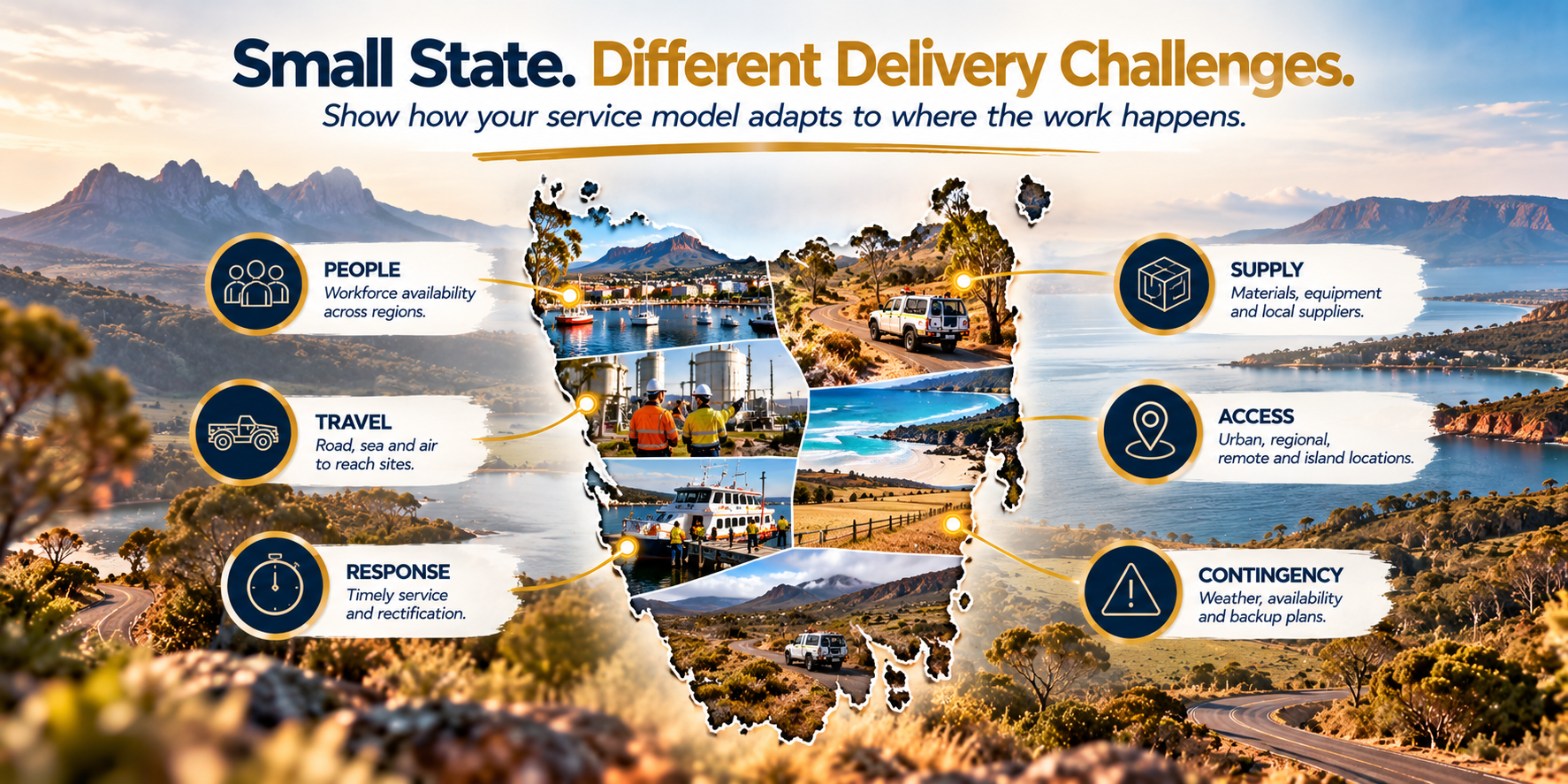
Small State Doesn't mean one Delivery Environment
Hobart isn't Launceston.
Launceston isn't Burnie.
And none of them is the same as delivering services on the West Coast, East Coast, King Island, Flinders Island or into Tasmania's more remote communities.
Depending on the contract, delivery may involve very different considerations around:
Travel.
Workforce coverage.
Response times.
Weather.
Freight and materials.
Subcontractor availability.
Equipment.
Site access.
Communications.
Contingency planning.
You don't need to manufacture complexity where it doesn't exist.
But where geography genuinely affects delivery, explain how your business manages it.
That's far more convincing than writing "we provide statewide coverage" and moving on.
Your People can be some of your Best Evidence
Tender responses tend to focus heavily on the company.
Sometimes the better story is sitting with the people who actually do the work.
The supervisor who knows the client's sites.
The project manager who has delivered the same type of contract for 12 years.
The tradesperson who started as an apprentice and now trains new employees.
The operations manager who knows exactly what happens when someone calls at 4.30 pm on Friday with an urgent job.
That knowledge matters.
So do qualifications, tenure, relevant projects, responsibilities and demonstrated results.
A good personnel response shouldn't read like a collection of CVs pasted into a tender.
It should explain why these are the right people to deliver this contract.
Government Suppliers have Responsibilities too
There's another 2026 change worth knowing about.
A new Tasmanian Government Supplier Code of Conduct took effect on 16 April 2026. Suppliers entering contracts to provide goods, services or works to the Tasmanian Government are required to comply with the Code.
That's part of a broader point I make regularly with clients:
Don't read only the response schedules.
The requirements that matter can be sitting in:
Conditions of contract. Specifications. Policies. Codes. Appendices. Schedules. Drawings. Addenda.
Occasionally, they're sitting somewhere that makes you wonder whether anyone actually wanted tenderers to find them.
Finding those requirements before we start writing can save considerable pain later.
Construction and Maintenance Tenders
For businesses tendering for Tasmanian Government building, construction and maintenance work, prequalification requirements can also apply.
Tasmania maintains prequalification arrangements for building construction and maintenance services, and Treasury introduced enhancements to its Prequalification Scheme from 1 July 2026.
But prequalification is only the gateway.
The tender itself may still ask you to explain exactly how you'll deliver the project.
That can mean:
Plan
Mobilise
Deliver
Inspect
Rectify
Report
Close Out
The evaluator needs to see the operation, not simply be told that you're experienced.

Tender Writing Support across Tasmania
TenderWise works remotely with businesses across Tasmania.
You don't need me sitting across the desk from you to explain how your business operates.
We'll talk.
I'll ask questions.
You'll probably tell me something that you consider completely ordinary.
I'll probably say:
"Hang on. That's actually important. Tell me more about that."
That's often how some of the best tender evidence emerges.
We can work together through phone, email, Teams and shared documents, whether you're in Hobart, Launceston, Devonport, Burnie or somewhere considerably further off the beaten track.
Industries We Work With
Tasmania's business community includes specialist trades, local contractors, regional service providers and businesses supporting tourism, infrastructure and essential community services. For many, their greatest strength is the local knowledge, relationships and hands-on experience they've built over time. We help Tasmanian businesses turn those strengths into clear, credible tender responses that show evaluators exactly what they can deliver.
Construction and Trades
Construction | Civil Construction & Earthworks | Electrical | Plumbing | Painting | Concreting | HVAC & Air Conditioning | General Trades
Facilities and Operational Services
Physical Security | Electronic Security | Cleaning | Landscaping | Catering & Canteen
Environmental and Professional Services
Waste & Recycling | Vegetation Management | Professional Services
What we can Help with
TenderWise can prepare a complete tender submission or support you with the parts that need additional work, including:
Full tender preparation.
Tender reviews.
Methodologies and service delivery responses.
Mobilisation and transition plans.
Economic and social benefit responses.
Tasmanian Industry Participation Plans.
Project examples and case studies.
Key personnel profiles and CVs.
Risk and management plans.
Supporting schedules and graphics.
Compliance and returnable reviews.
Already written your tender?
We can provide a fresh set of eyes before you lodge it.
Ready to Talk about a Tasmanian Tender?
Send me the tender documents and tell me a little about the opportunity.
I'll look at what's involved, what the buyer is actually asking for and where TenderWise can help.