
Northern Territory Tenders
Tender Writing for Northern Territory Businesses
Tendering in the Northern Territory can ask some very practical questions.
Not just:
Can you do the work?
But:
Can you do it there?
Can you mobilise the right people? Get equipment and materials where they're needed? Maintain service coverage across large distances? Work effectively with local and Aboriginal businesses? Manage weather, access and communications? Respond when something doesn't go according to plan?
For many Territory contracts, capability isn't just about technical expertise.
It's about proving that your delivery model works in the environment where the contract will actually be delivered.
TenderWise helps businesses turn that capability into clear, practical and evidence-based tender responses.
Remote doesn't mean simple. Your tender shouldn't pretend it does.
Finding Tender Opportunities in the Northern Territory
Quotations and Tenders Online - QTOL is the main portal for Northern Territory Government procurement opportunities.
Most government work valued above $200,000 is publicly advertised through QTOL. Businesses can also see future tender opportunities and awarded contracts, while the NT Government publishes a five-year tender forecast to give suppliers greater visibility of upcoming work.
That's particularly useful in the Territory.
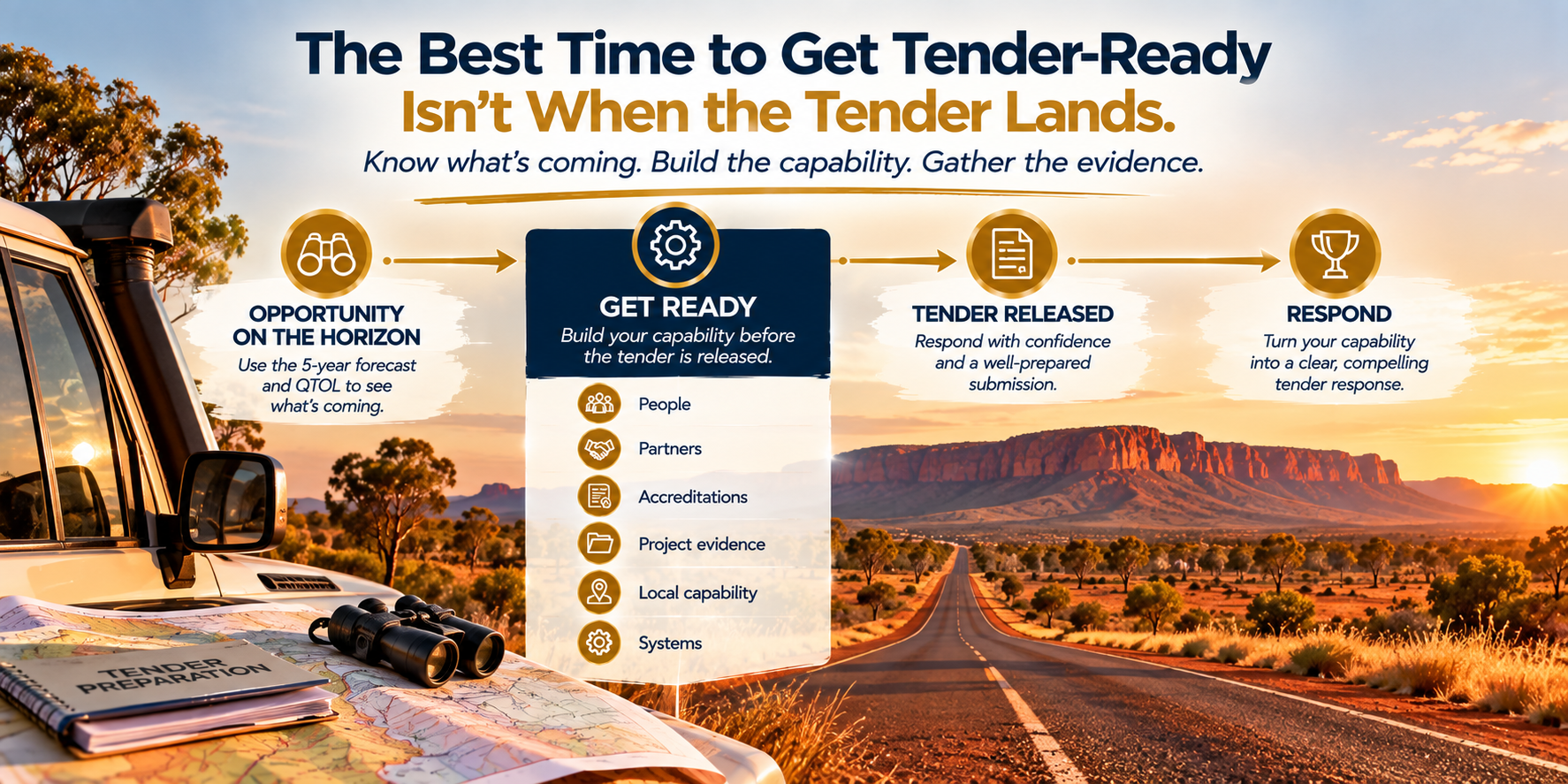
If a future contract will require additional people, vehicles, equipment, local partners or regional capability, knowing what's coming gives businesses time to prepare rather than trying to assemble everything during a four-week tender period.
And not every opportunity is a major public tender.
Under the current procurement tiers, purchases below $50,000 generally require at least one quote from a Territory business, while purchases from $50,000 to $200,000 require a minimum of three quotes, including two from Territory businesses. Public tendering begins at $200,000 under the standard process.
So being visible and tender-ready before an opportunity lands can matter too.
Value for Territory is Bigger than Price
The Northern Territory Government's procurement framework is built around Value for Territory.
That means procurement isn't assessed purely on obtaining the lowest price. Current government guidance says evaluation can consider capability, relevant experience and past performance, local jobs and suppliers, Aboriginal participation where applicable, risk and safety, and innovation or technical merit.
The broader procurement framework also identifies five principles:
Value for Territory.
Ethical Behaviour and Fair Dealing.
Open and Effective Competition.
Enhancing Territory Enterprises and Supply Chains.
Environmental Protection.
For a tenderer, the practical message is fairly simple.
Don't make the evaluator work out why your offer represents value.
Show them.
Local Capability Needs Evidence
The NT Government's Buy Local Plan supports Territory enterprises and requires local content information in relevant tenders and quotations. Government agencies must consider local benefit when assessing offers.
That makes statements such as:
We are committed to supporting the local economy.
That’s a starting point, not an answer.
A stronger response might identify:
Territory-based employees.
Local offices, depots or facilities.
Territory suppliers.
Local subcontractors.
Equipment based in the Territory.
Local expenditure.
Training and employment opportunities.
Existing regional relationships.
Local decision-making and management capability.
If the contract creates additional opportunities, explain those too.
Who benefits? Where? How? And can you measure it?
That's evidence.
Remote Delivery needs more than a Dot on a Map
The Northern Territory covers an enormous area, but distance is only part of the challenge.
Delivery can also be affected by weather, seasonal access, road conditions, freight, workforce availability, accommodation, communications, equipment availability and the sheer practicalities of getting people and resources where they're needed.
A contract covering Darwin, Palmerston and Litchfield may require one delivery model.
Central Australia may require another.
The Top End, Barkly, Big Rivers or East Arnhem may introduce different considerations again. QTOL itself allows suppliers to identify opportunities across these different Territory regions.
If you're tendering for geographically dispersed work, don't simply write:
"We have the capability to service the entire Northern Territory."
Show how.
Who responds?
Where are they based?
What vehicles and equipment are available?
Where does backup come from?
How do you replenish stock?
What happens if a road is closed?
How do supervisors maintain oversight?
What happens when the plan stops going according to plan?

Aboriginal Participation can be Part of the Contract
Aboriginal participation is another important component of Northern Territory procurement.
The NT Government's Aboriginal Procurement Policy is designed to increase Aboriginal participation in government contracting. It establishes targets relating to contracts and contract value awarded to Aboriginal businesses as well as Aboriginal employment on applicable contracts. Contractors may need to provide evidence of Aboriginal participation in delivery.
For tenderers, that can mean thinking seriously about:
Aboriginal employment.
Aboriginal business subcontracting.
Supply-chain opportunities.
Training and development.
Regional partnerships.
Engagement with local organisations.
Responsibilities for delivering commitments.
Monitoring and reporting.
The key word is credible.
Don't invent an Aboriginal participation strategy because the tender asks for one.
Look at the contract, the communities involved and the capability that already exists - then identify commitments the business can genuinely deliver.
A realistic plan backed by actual relationships is much stronger than a page of good intentions.
Local Partners can be Part of the Capability Story
Sometimes the strongest delivery model doesn't involve pretending your business can do absolutely everything itself.
It might involve established subcontractors.
Regional suppliers.
Specialist partners.
Aboriginal businesses.
Local trades.
Freight providers.
People who know the area and already have capability on the ground.
That isn't necessarily a weakness in a tender.
Properly explained, it can be evidence of a mature delivery model.
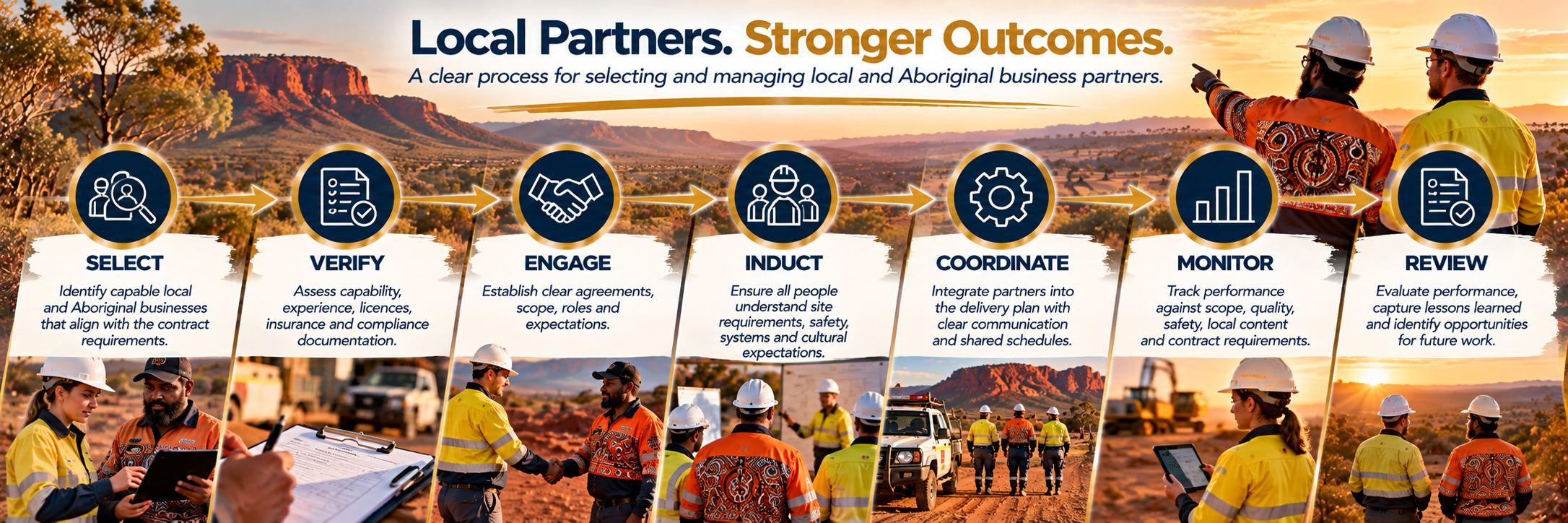
The response should show how those relationships work:
Select
Verify
Engage
Induct
Co-ordinate
Monitor
Review
Who is responsible?
How are partners selected?
What standards apply?
How is performance monitored?
How does information flow back to the contract manager?
That's what turns a list of subcontractors into a delivery strategy.
Mobilisation starts before Anyone heads to Site
Mobilisation can be particularly important for NT contracts.
The business may need to coordinate people, vehicles, equipment, accommodation, freight, communications, inductions, systems, licences, suppliers and subcontractors before service commencement.
And some things have long lead times.
A credible mobilisation response therefore needs more than:
Upon contract award, we will commence mobilisation.
Well, yes. One would hope so. 😁
The useful part is explaining what happens next.
Who takes control?
What gets validated first?
What can happen concurrently?
Which activities are on the critical path?
What needs client input?
What could delay commencement?
What contingency exists?
The evaluator should be able to look at the plan and think:
They've actually thought about how this is going to work.
When Conditions Change, the Delivery Model has to Change with them
Remote and regional delivery also makes contingency planning important.
A tender doesn't need to contain a disaster novel describing every conceivable thing that might go wrong.
It does need to demonstrate that the business understands its operational vulnerabilities.
That might include:
Severe weather.
Flooding and road closures.
Vehicle or equipment breakdown.
Staff unavailability.
Freight delays.
Supply disruption.
Communications outages.
Accommodation constraints.
Subcontractor unavailability.
Emergency response.
For each significant risk, the useful question isn't simply:
What's the risk?
It's:
What will we actually do about it?

Past Performance Matters after the Tender too
There is another reason not to overpromise.
Under the current NT procurement rules, agencies monitor supplier performance during contracts. Performance information can be considered in future procurement planning and when assessing subsequent offers.
Performance can include areas such as quality, compliance, timeliness, communication, responsiveness and risk management.
So winning the tender isn't the end of the story.
The commitments in the submission need to survive contact with the actual contract.
That's something worth remembering whenever we're tempted to add another impressive promise.
Read more than the Response Schedule
NT Government suppliers are also required to comply with the NT Procurement Code, which applies across government procurement regardless of value. It covers legal compliance, ethical conduct, workplace responsibilities and other supplier obligations.
And that illustrates a broader tender lesson.
The important requirements aren't always sitting neatly beside a box marked Your Response.
They may be in:
Conditions. Specifications. Policies. Codes. Schedules. Drawings. Addenda. Contract clauses.
Part of preparing a strong tender is understanding all of them before we start enthusiastically answering questions.
Construction and Infrastructure Tenders
Construction and infrastructure businesses can face additional requirements.
NT Government guidance notes that suppliers may require industry licences or accreditation such as Contractor Accreditation Limited - CAL - for construction projects.
Then comes the actual tender.
The buyer may want to understand:
Project methodology.
Mobilisation.
Workforce.
Plant and equipment.
Remote delivery.
Subcontractor management.
Safety.
Quality.
Environmental management.
Traffic and public interface.
Program and milestones.
Risk.
Reporting.
Local and Aboriginal participation.
That's a lot more than demonstrating you know how to build something.
It's demonstrating that you know how to deliver this project, in this location, under this contract.
Tender Writing Support across the Northern Territory
TenderWise works remotely with businesses tendering throughout the Northern Territory.
We don't need to be sitting in the same room.
What I do need is access to the people who understand how the business actually operates.
We'll talk through the opportunity.
I'll read the documents.
I'll ask questions.
Then I'll probably ask more questions because one of your answers has revealed something useful that wasn't in any of the documents you sent me.
That's generally where the good stuff is.
Whether the contract is based in Darwin, Alice Springs, Katherine, Tennant Creek or extends into regional and remote locations, the objective is the same:
Make the evaluator understand how your business will deliver.
Industries We Work With
Tendering in the Northern Territory can involve challenges that businesses elsewhere rarely encounter, from remote service delivery and long supply chains to workforce availability and demanding operating conditions. Whether you're delivering services in Darwin, supporting regional communities or working across remote locations, a strong tender needs to demonstrate more than technical capability. We help NT businesses explain how they'll mobilise, manage risks and deliver reliably in the environments where they'll actually be working.
Construction and Trades
Construction | Civil Construction & Earthworks | Electrical | Plumbing | Painting | Concreting | HVAC & Air Conditioning | General Trades
Facilities and Operational Services
Physical Security | Electronic Security | Cleaning | Landscaping | Catering & Canteen
Environmental and Professional Services
Waste & Recycling | Vegetation Management | Professional Services
What we can help with
TenderWise can prepare the complete submission or help with specific parts of your tender, including:
Full tender preparation.
Tender reviews.
Methodologies and service delivery responses.
Mobilisation and transition plans.
Remote and regional delivery methodologies.
Local content responses.
Aboriginal participation responses.
Project examples and case studies.
Key personnel profiles and CVs.
Risk and management plans.
Supporting schedules and graphics.
Compliance and returnable reviews.
Already written your response?
We can also provide a fresh set of eyes before you lodge it.
Ready to Tackle an NT Tender?
Send me the tender documents and tell me a little about the opportunity.
I'll look at what's involved, what the buyer is asking for and where TenderWise can help.