
Our Work
Every Tender Starts with a Different Business
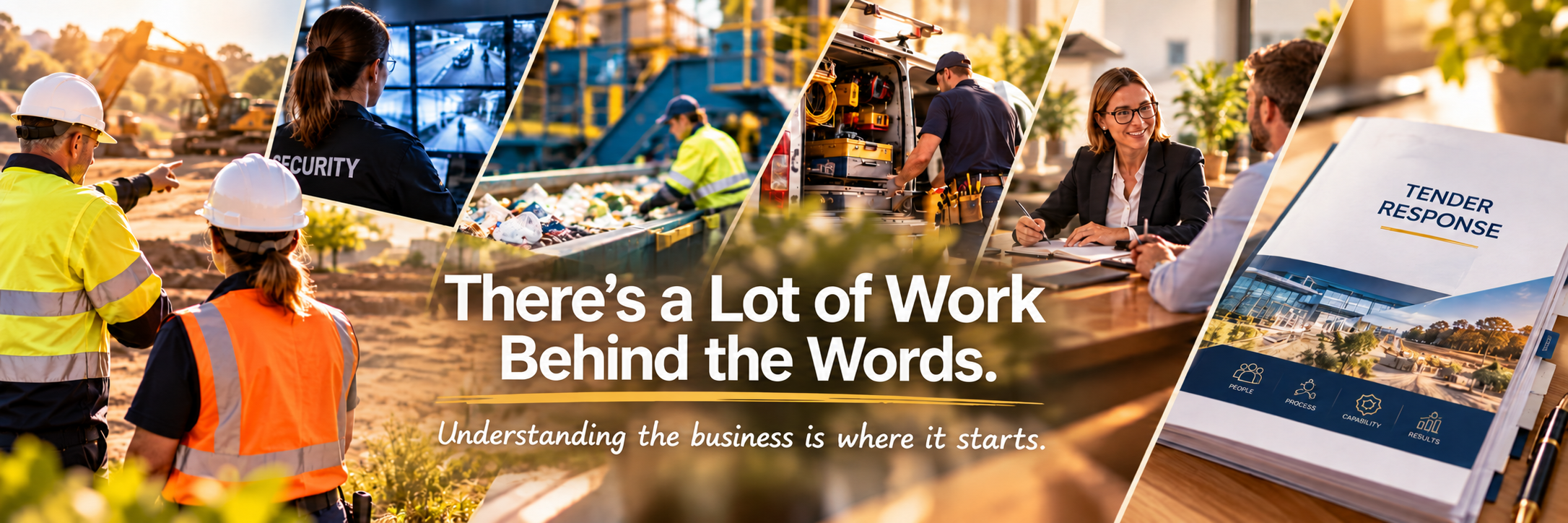
One week I might be working through the mobilisation of a 24/7 security workforce.
The next, I'm trying to understand exactly what happens between a council issuing a work order and a concreting crew closing it out.
Then I might be asking questions about recycling contamination, electrical response times, vegetation management around critical infrastructure or how a professional services consultancy governs a national program.
That's one of the things I love about this work.
I get to step inside businesses I might otherwise never encounter, understand how they operate and work out what an evaluator needs to know about them.
Because while the finished product may be a tender response, there's a lot of work behind the words.
The Writing is only Part of the Job
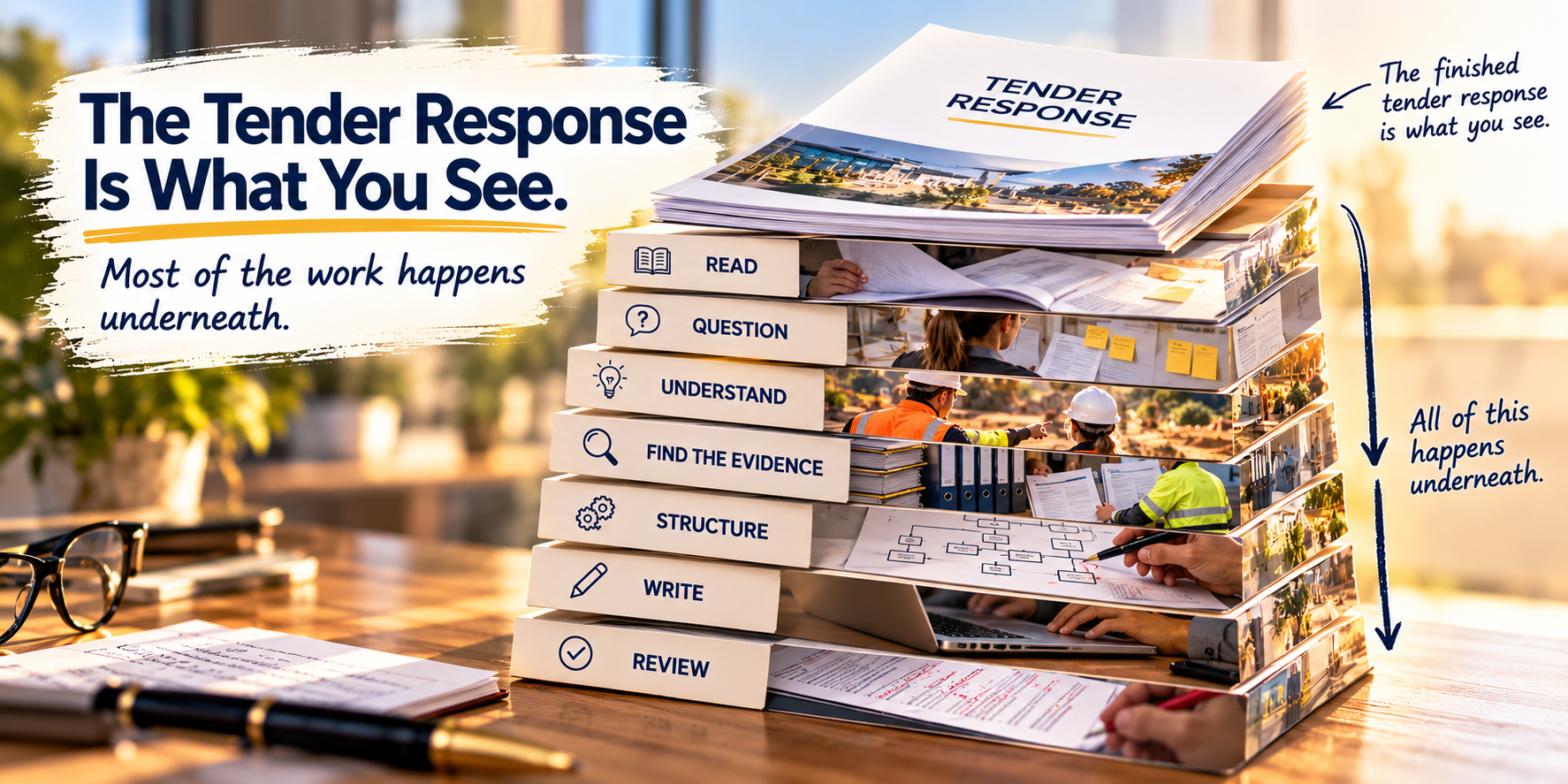
By the time I start properly writing a tender response, quite a lot has usually already happened.
I've read the tender documents.
I've worked out what the buyer is asking for.
I've probably found several things they didn't ask particularly clearly.
I've identified information we need from the client.
I've asked questions.
And then I've asked some more.
I've looked through existing policies, procedures, project examples, CVs, capability documents and anything else that might contain useful evidence.
Only then does the writing really begin.
Because a strong tender response isn't created by finding impressive words.
It's created by understanding the business well enough to explain why it can deliver the contract.
Turning Everyday Operations into a Methodology
This is one of the most common things I do.
A client knows exactly how their business operates.
A job comes in. Someone assesses it. Resources are allocated. The work is planned. The crew turns up. The job gets done. Someone checks it. Records are completed. The client is updated.
To them, that's simply Tuesday.
To an evaluator, it's a methodology.
The challenge is getting everything that's happening inside the business out of people's heads and onto the page in a way that is clear, structured and credible.
That might mean documenting:
How work is received, prioritised and allocated.
Who makes decisions and when.
How people, equipment and materials are scheduled.
What happens before work starts.
How safety, environmental and quality controls are applied.
How progress is monitored.
How problems and changes are escalated.
How work is inspected and verified.
What gets recorded and reported.
How the job is formally closed out.
The business may have been doing all of that successfully for 20 years.
My job is to make the operation visible.
Finding the Evidence Behind the Claim
Businesses naturally describe themselves using words like experienced, reliable, responsive and professional.
Tender evaluators need more.
So we dig deeper.
“Experienced team” might become long-serving employees, relevant qualifications and hundreds of completed projects.
“Responsive service” might become a 24/7 contact point, defined triage process, escalation arrangements and measurable response times.
“Strong client relationships” might become repeat contracts, extensions and 14 years of continuous service.
“Robust systems” might become an actual workflow showing how work is received, assigned, tracked, checked and reported.
The claim isn't necessarily wrong.
We just need to find the evidence that makes it believable.
Making Complex Mobilisation Understandable
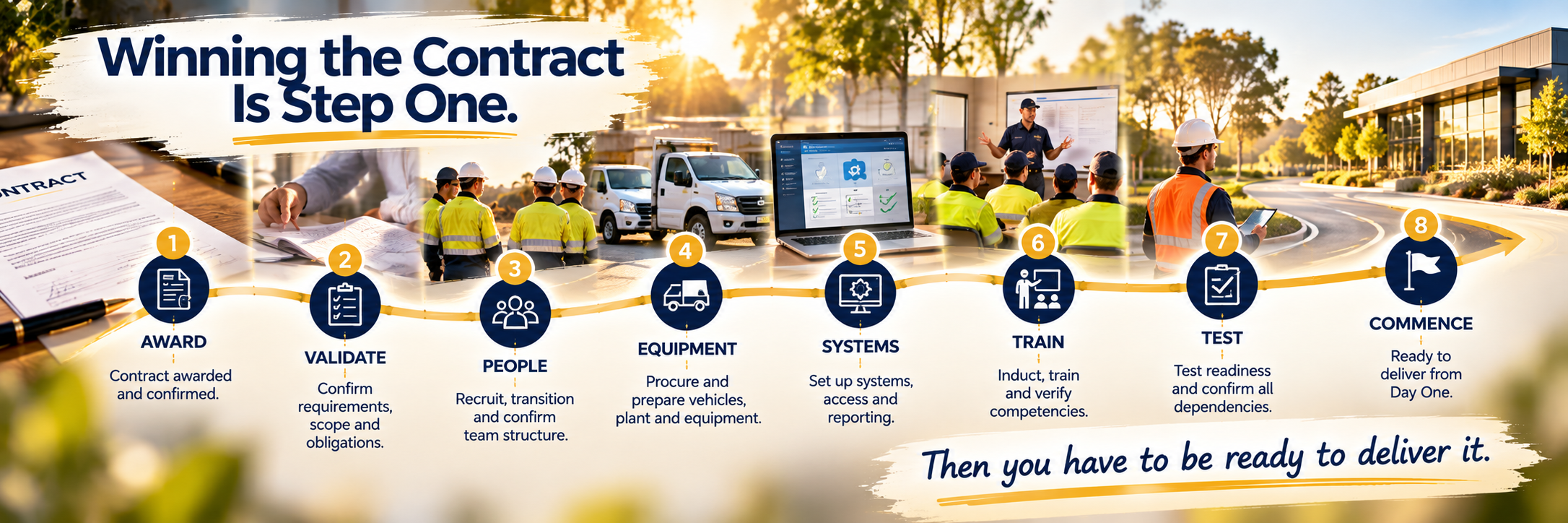
For larger contracts, winning the tender is only the beginning.
There may be people to recruit or transition. Vehicles and equipment to procure. Systems to configure. Sites to inspect. Training to complete. Licences and competencies to verify. Stakeholders to meet. Rosters to build. Reporting arrangements to establish.
And all of it may need to happen within a relatively short mobilisation period.
A good mobilisation response doesn't simply promise to be ready by the commencement date.
It shows how.
We break the transition into logical activities, responsibilities, milestones, dependencies and checks so the evaluator can see how the business intends to move from contract award to operational readiness.
Working Through the Fine Print
Sometimes the tender question is only the beginning.
The information that changes the answer might be buried in the specification.
Or the contract.
Or an appendix.
Or the pricing schedule.
Or a KPI table 150 pages away.
Tender packages don't always arrive as beautifully coordinated masterpieces.
Requirements can overlap. Documents can contradict one another. Something described as mandatory in one place may barely be mentioned elsewhere.
And occasionally something makes me stop and think:
Hang on. What's going on here?
Part of my work is identifying those things early enough to do something about them - whether that means changing the response, asking the client another question, raising a clarification with the buyer or simply making sure an obligation hasn't been overlooked.
Building the Supporting Story
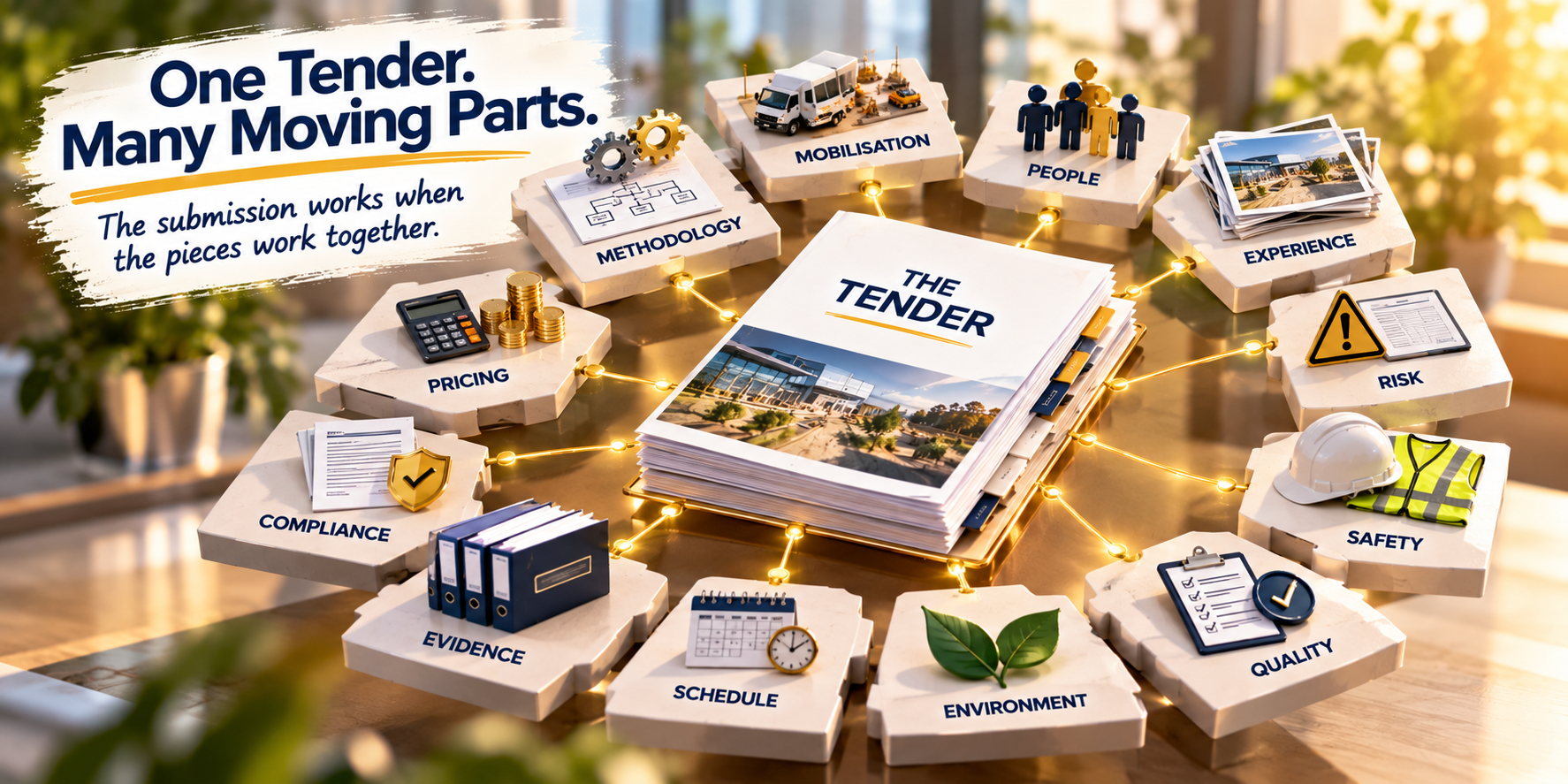
The written responses are often only part of a submission.
Depending on the tender, we may also need to develop or strengthen supporting material such as:
Mobilisation and transition plans.
Service delivery methodologies.
Risk registers and risk management plans.
Quality, safety and environmental information.
Project examples and case studies.
Key personnel profiles and CVs.
Organisational and contract management structures.
Implementation schedules and Gantt charts.
Business continuity and emergency arrangements.
Social procurement and sustainability responses.
Process diagrams and supporting graphics.
These aren't documents we create simply to make the submission look impressive.
Each should help answer a question the evaluator is ultimately asking:
Can this business actually deliver what we're buying?
Sometimes the Best Material is already there
One of the interesting things about tender writing is how often the strongest evidence already exists inside the business.
It just wasn't created for a tender.
It might be a spreadsheet used to monitor response times.
A toolbox process that's been refined over years.
A supervisor who's been with the company since almost the beginning.
A client who's renewed the contract three times.
A reporting dashboard.
A lesson learned after something went wrong.
A system someone built because the off-the-shelf options didn't work.
Clients will sometimes mention something almost in passing and I'll think:
Wait. Go back. Tell me more about that.
Because something that's completely ordinary inside the business can be exactly the evidence an evaluator needs.
The Work has Taken me just about Everywhere
Over the years, TenderWise has supported businesses tendering to Australian Government agencies, state governments, councils, utilities, universities, major corporations and other organisations across Australia.
The work has covered security, construction, civil works, electrical services, plumbing, HVAC, cleaning, waste and recycling, vegetation management, landscaping, facilities maintenance, electronic security and professional services - along with quite a few things that are considerably harder to categorise.
Some submissions are enormous.
Some are surprisingly small.
Some arrive beautifully organised.
Some most definitely do not.
But every one starts in essentially the same place:
What does the buyer need - and what can this business genuinely deliver?
Different Businesses need Different Tenders
Having worked across so many industries is useful.
But not because it gives me a library of old responses to recycle.
Quite the opposite.
The more businesses I've worked with, the more obvious it has become that the good stuff is usually in the differences.
The people.
The systems.
The experience.
The way problems are solved.
The way customers are looked after.
The things the business has learned.
The way the work actually gets done.
That's why TenderWise doesn't start with a template and try to make your business fit.
We start with your business.
What Does the Work Lead To?
Hopefully, a win.
And there is still nothing quite like opening an email from a client that begins:
“WE WON!”
But not every tender will be successful, and no credible tender writer should pretend otherwise.
What I can do is help make sure your submission gives the evaluator a clear, credible and evidence-based picture of the business behind it.
And when clients come back for the next tender - and the one after that - I reckon that says something about the work too.
Want to Know What our Clients Think?
You don't have to take my word for it.
Some of my favourite emails over the years have come from clients telling me what happened after we pressed Submit.
Testimonials
“Wow you are freaking amazingggggg!!!!! These documents look incredible. Thank you so much!”- Adrian Dossantoss, Managing Director, Santos Construction Group
“Dear Pauline, I wanted to express my sincere gratitude for the exceptional service provided by TenderWise in assisting with our recent tender submission. From the outset, your professionalism and attention to detail were evident. The guidance and support you provided throughout the tender process were invaluable, contributing to a comprehensive and compelling submission. Your insights and suggestions greatly enhanced the overall quality of our proposal. In summary, working with TenderWise has been a seamless and positive experience. I highly recommend your services to anyone seeking professional assistance with tender submissions and related projects. Your expertise and commitment to client success truly set you apart.” - Aaron Dillion, Director, McHugh & Eastwood
“Hi Pauline, I just wanted to let you know we were successful!!!! Have a look at the email below, We got everything we wanted!!! :)
Thanks so much for all your hard work, we really appreciate everything you did for us!! - Edel Phillips, Phillips Builders
Or, if you've got a tender sitting in front of you right now:
Read about our Tender Writing Services
Read about our Tender Review Services