Government Tenders: Make it easy for the Evaluator to see your Capability
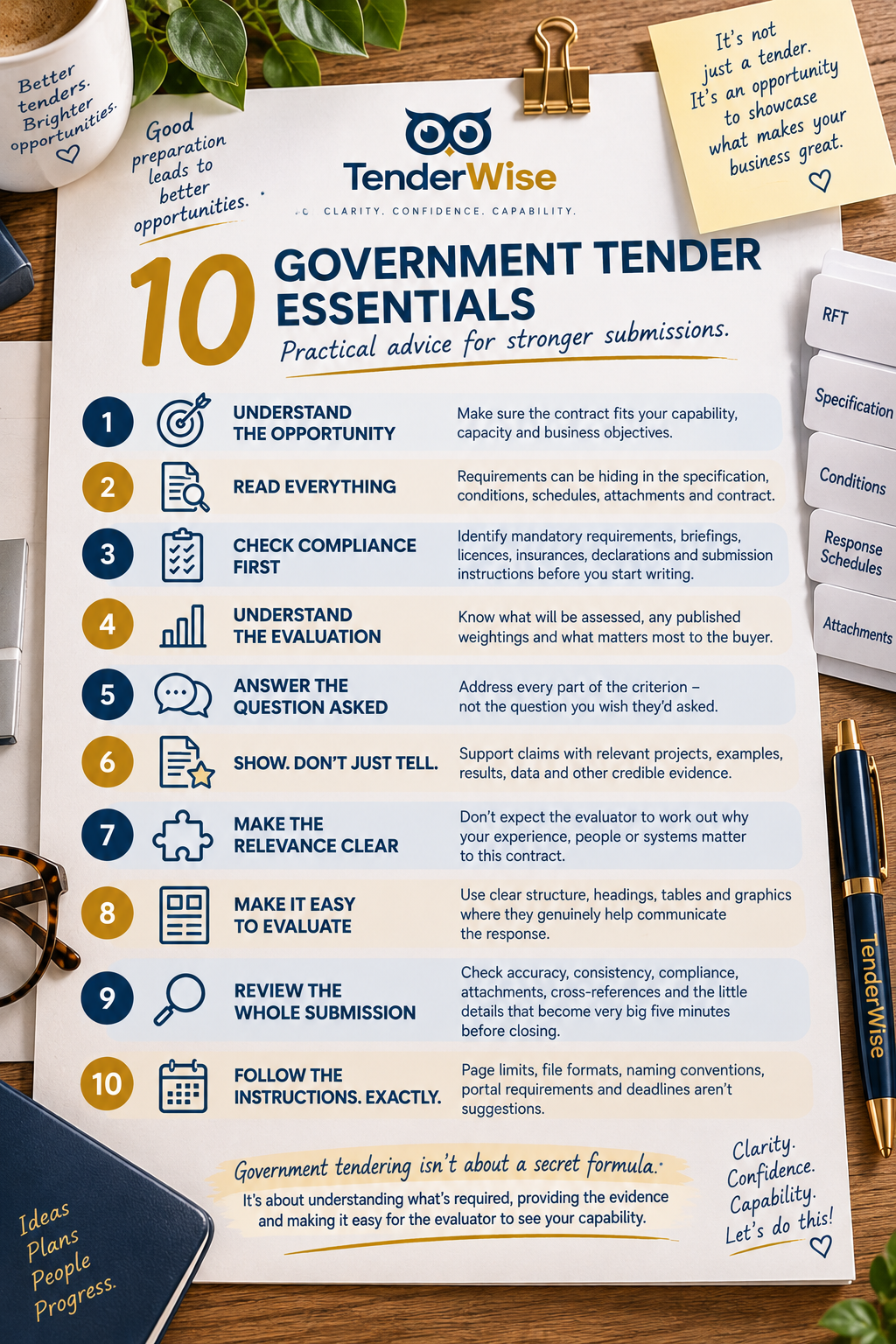
Government tenders can look complicated. Usually, the real challenge is working out what the evaluator actually needs to know.
A government tender might ask about your experience, methodology, people, WHS, quality, environmental management, risk, sustainability, social procurement, transition arrangements, KPIs and a dozen other things before you even reach the pricing schedule.
And somewhere amongst all of that will be conditions, schedules, attachments and mandatory requirements that you really don't want to discover five minutes before submission.
The trick isn't simply answering every question.
It's understanding why they're asking it - and giving the evaluator the evidence they need to feel confident in your business.
TenderWise helps Australian businesses prepare clear, evidence-based responses for Local, State and Australian Government tenders.
Government Tendering is Different
Government procurement tends to be structured.
That's actually a good thing.
The tender documents usually tell us what the buyer wants, how the contract is expected to operate, what information must be submitted and, often, how responses will be evaluated.
The challenge is finding all of that information, understanding how it fits together and making sure the response addresses it.
Important requirements aren't always conveniently located under a heading called:
IMPORTANT THINGS YOU MUST NOT MISS.
Wouldn't that be lovely? 😂
They can appear in the conditions of tendering, specification, contract, response schedules, appendices or somewhere in a seemingly innocent note on page 73.
That's why my work on a government tender starts with the documents, not the writing.
Before we Write, we need to Understand
When you send me a government tender, I review the documentation before providing a proposal.
I'm looking at things such as:
The scope of services or works;
Mandatory requirements and conditions of participation;
Evaluation criteria and any published weightings;
Response schedules and page or word limits;
Contract requirements and departures;
Insurances, licences and certifications;
Required plans, policies and supporting documents;
Sustainability, social procurement and local-content requirements;
Pricing schedules and assumptions;
Briefing sessions, site visits and clarification deadlines; and
Submission instructions and closing requirements.
That review tells us what we're dealing with.
It also helps identify potential issues before we spend days developing the response.
Compliance gets you Through the Door. Evidence Gives the Evaluator Something to Assess.
Government tender responses often involve two quite different jobs.
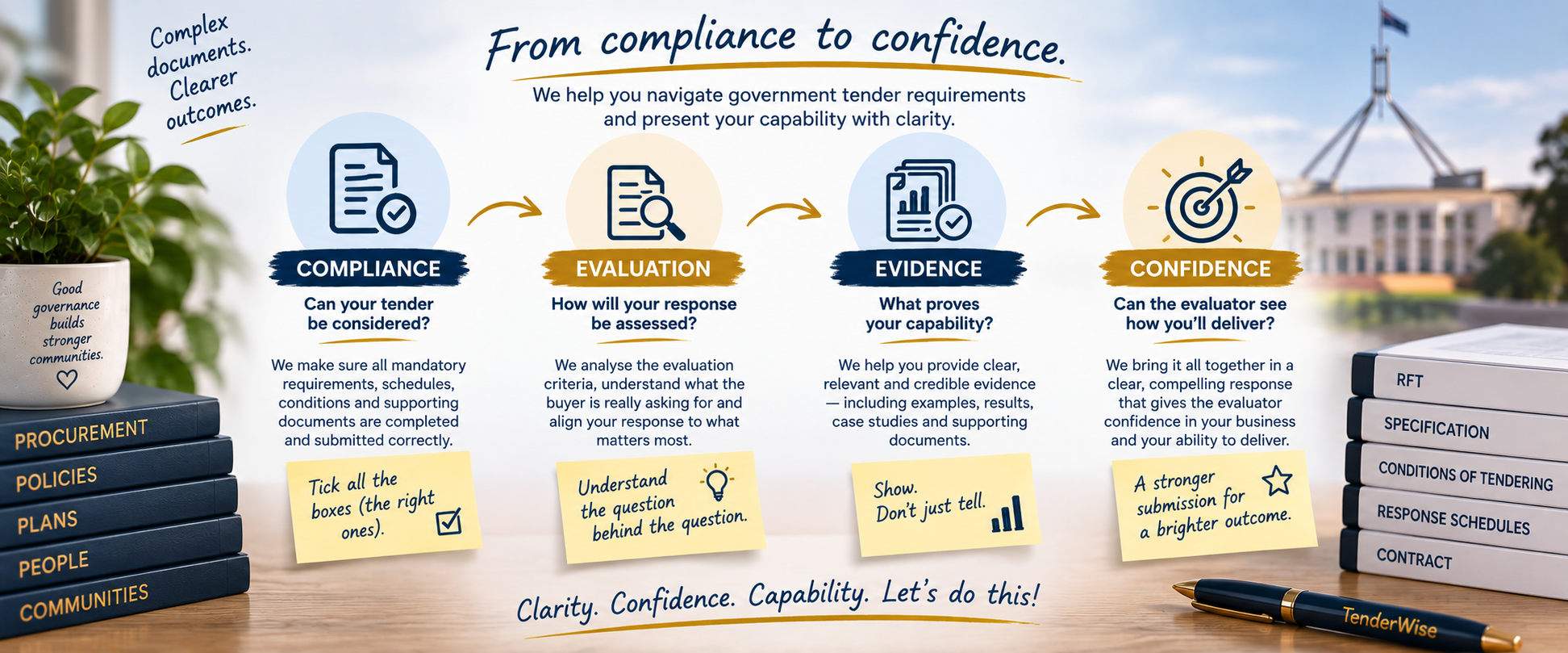
The first is compliance.
Have you completed the required schedules? Do you hold the necessary licences and insurance? Have you acknowledged the conditions? Have you supplied the mandatory documents? Have you followed the submission instructions?
Miss a mandatory requirement and the quality of your beautifully written methodology may become completely irrelevant.
The second job is evaluation.
This is where the buyer considers the quality of your offer against the published criteria.
And this is where vague claims become a problem.
“We have extensive experience delivering similar contracts.”
Which contracts?
How similar?
What did you deliver?
For whom?
What happened?
What did you achieve?
Government evaluators need something they can assess.
My job is to help make sure it's there.
Answer the Question Behind the Question
Government tender questions aren't always beautifully written.
Sometimes they're straightforward.
Sometimes one question asks approximately seven different things in a single paragraph and leaves you contemplating whether whoever wrote it has a personal grudge against tenderers.
Either way, I look beyond the wording to understand what confidence the buyer is trying to gain from the response.
If they ask about mobilisation, they're not simply asking for a list of activities.
They want confidence that you'll be ready to deliver when the contract starts.
If they ask about business continuity, they want to know what happens when something goes wrong.
If they ask about key personnel, they want to understand whether the people responsible for the contract have the capability and availability to deliver it.
If they ask about performance management, they want to know how you'll measure service delivery, identify problems and improve performance.
Understanding why the question matters usually leads to a much stronger answer.
What Government Evaluators may want to See
Every procurement is different, but government tenders commonly ask businesses to demonstrate capability across areas such as:
Relevant Experience
Comparable contracts, project examples, outcomes, lessons learned and referee information.
Service Delivery
Methodology, contract management, mobilisation, transition, scheduling, communication and day-to-day operations.
People & Resources
Key personnel, qualifications, workforce capacity, organisational structures, recruitment, training and contingency resources.
Quality, WHS & Environment
Management systems, policies, procedures, inspections, audits, incident management, environmental controls and continuous improvement.
Risk & Business Continuity
Operational risks, controls, escalation, emergency response, contingency arrangements and recovery.
Performance & Reporting
KPIs, reporting, meetings, issue management, corrective actions and performance improvement.
Sustainability & Social Procurement
Environmental initiatives, local participation, Indigenous participation, employment outcomes, ethical procurement, modern slavery and broader social value where relevant.
Value for Money
Not simply the lowest price, but the relationship between price, capability, risk, quality and the outcomes offered by the tenderer.
The important words there are where relevant. We don't shoehorn every fashionable procurement phrase into every response.
We address what this buyer and this tender actually require.
Your Existing Experience may be more Relevant than you Think
One of the most common concerns I hear is:
“We haven't worked for government before.”
That doesn't necessarily mean you can't demonstrate relevant experience.
The evaluator may be interested in the nature, scale, complexity and outcomes of your previous work rather than whether your client happened to be a government department.
A commercial contract may demonstrate exactly the capability they're looking for.
Likewise, the experience of your key personnel may be relevant even if they gained it before joining your business.
The important thing is to explain the connection.
We don't pretend experience is something it isn't.
We show the evaluator why the experience you genuinely have is relevant to the contract you're tendering for.
Government Tender Experience Across Australia
TenderWise has developed tender responses for businesses pursuing opportunities with Local, State and Australian Government buyers across Australia.
NSW | VIC | QLD | SA | TAS | ACT | WA | NT |
That experience spans a broad range of services and industries, including:
Cleaning | Construction | Civil Works | Concreting | Electrical | General Trades | Landscaping | Painting | Professional Services | Security | Vegetation Management | Waste & Recycling | Electronic Security |
TenderWise's published project history includes submissions involving councils, government departments, statutory authorities and other public-sector organisations across multiple jurisdictions.
But government experience isn't valuable because it means I've memorised some magical formula for writing a government tender.
There isn't one.
It's valuable because I've spent an alarming amount of my working life reading tender documents.
I know to look for the requirement buried in the attachment, the qualification hidden in the contract, the question that hasn't quite asked what it appears to ask, and the piece of evidence we haven't yet included.
Supporting Documents Matter Too
Sometimes the response itself is only part of the job.
Government tenders can require supporting documents such as:
WHS Management Plans
Quality Management Plans
Environmental Management Plans
Risk Management Plans
Business Continuity Plans
Emergency Management Plans
Mobilisation or transition plans
Modern slavery policies
Sustainability or social procurement plans
Organisational charts
Project programs and implementation schedules
Risk registers
Case studies;
Resumes for key personnel.
If you've already got them, great - I'll look at how they support the tender and where we should reference them.
If something important is missing, TenderWise can often help develop it.
Federal, State and Local Government Tenders
TenderWise works with businesses responding to opportunities across all levels of Australian government.
The procurement processes, terminology and requirements can vary between jurisdictions and agencies, but the fundamental principle remains the same:
Read what they've asked for. Understand why it matters. Provide the evidence. Make it easy to evaluate.
If you're looking for assistance with tenders in a particular state or territory, you can also visit:
NSW | Victoria | Queensland | South Australia | ACT | Tasmania | Western Australia | Northern Territory
What Working with TenderWise Looks Like
You send me the tender documentation.
I review it before quoting so I understand the requirements and the amount of work involved.
If you decide to proceed, we'll identify what information and supporting documents I need. I'll work through the evaluation criteria, ask the questions that help uncover the evidence and progressively develop the response for your review.
Where something isn't clear, we'll identify whether a clarification should be raised with the buyer.
Where there's a gap, we'll work out how it should be addressed.
Where you've given me three words and I suspect there's a much better answer hiding behind them, I'll keep asking questions.
You bring the knowledge of your business.
I bring the tender-writing experience and a (possibly unhealthy) willingness to read procurement documents from beginning to end.
Got a Government Tender Sitting in your Inbox?
Send it through - I'll review the tender documentation and let you know what's involved, how I can help and the professional fee for developing the response.
No promises of guaranteed wins. No secret government-tender formula. And definitely no copy-and-paste response that could belong to any business.
Just a clear, well-developed submission designed to help the evaluator understand what your business can do, how you'll deliver and why the evidence supports it.