

Physical Security Tenders
Security Tender Writing for Government and Commercial Contracts
Security tenders can range from a single-site guarding contract to complex multi-site operations involving hundreds of security hours every week.
Depending on the opportunity, you may need to demonstrate capability across:
Static guarding.
Mobile patrols.
Concierge and front-of-house security.
Control room operations.
Alarm response.
Security monitoring.
Access control.
Lock-up and unlock services.
Incident response.
Emergency response.
Event security.
Crowd management.
Contractor and visitor management.
After-hours services.
Key management.
Welfare checks.
Asset protection.
Customer service.
Multi-site operations.
24/7 service delivery.
TenderWise helps bring those individual services together into a response that demonstrates how your security operation works as a whole.
A Security Officer is only as Strong as the Operation Behind them
One of the biggest mistakes in a security tender is focusing almost entirely on the officers.
They're obviously important.
But the evaluator also needs confidence in everything supporting them.
What happens when someone calls in sick 30 minutes before their shift?
Who notices if an officer hasn't arrived?
How is a vacant shift filled?
Who supports an officer dealing with a serious incident at 2.00 am?
How does information move between shifts?
Who reviews incident reports?
How are recurring problems escalated?
How does management know the contract is performing as promised?
A strong tender response makes the support structure behind frontline service delivery visible.
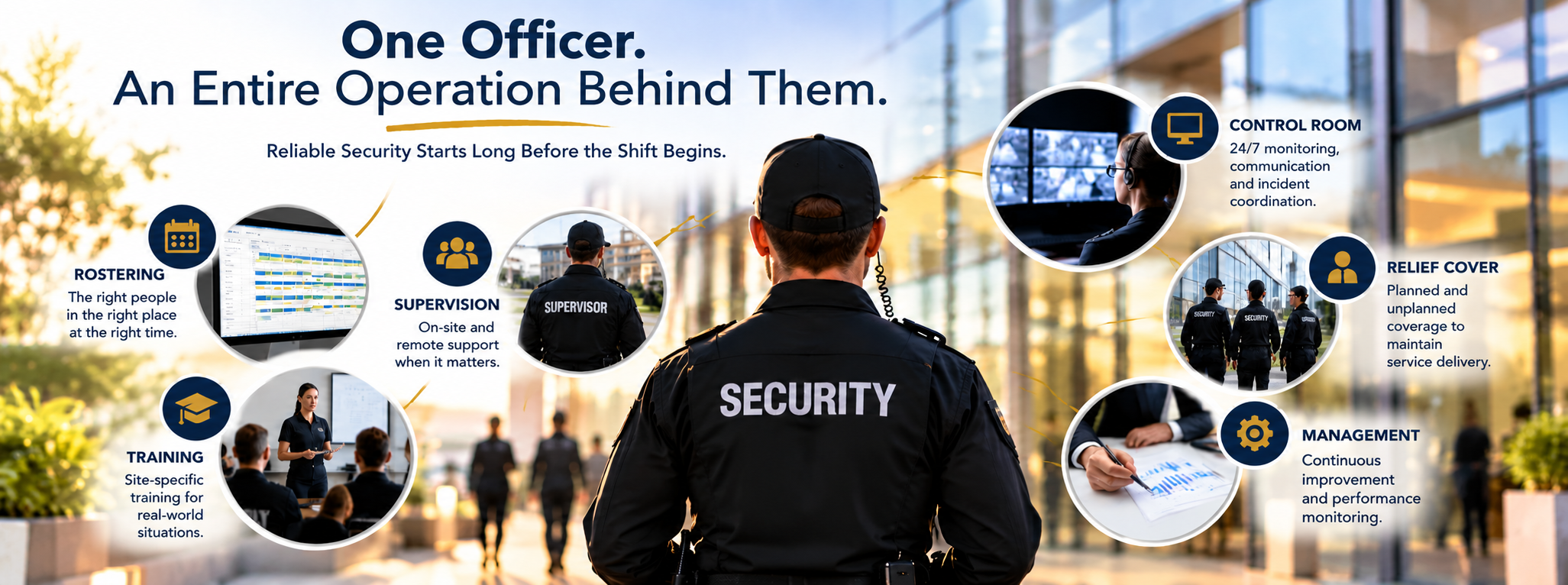
The Right People in the Right Place at the Right Time
Security is a people-intensive service.
That makes workforce management one of the most important parts of the contract.
A tender may ask you to demonstrate how you will:
Recruit suitable personnel.
Verify licences and qualifications.
Conduct background checks.
Assess suitability for individual sites.
Retain incumbent personnel.
Manage employee availability.
Develop rosters.
Provide relief coverage.
Manage fatigue.
Fill unplanned vacancies.
Maintain surge capacity.
Monitor attendance.
Manage leave.
Retain experienced officers.
Address performance issues.
Simply saying you have access to a large pool of security officers doesn't necessarily answer those questions.
We help explain the process behind workforce reliability.
Mobilisation starts with People
For an incumbent security contract, mobilisation can be particularly sensitive.
The client wants continuity.
Existing officers may want certainty.
Your own employees need to be recruited or allocated.
Training needs to happen.
Rosters need to be built.
Uniforms and equipment need to be ready.
Systems need to be configured.
Site knowledge needs to be transferred.
And the security operation still needs to work perfectly when the new contract starts.
A mobilisation methodology might include the information shown below:
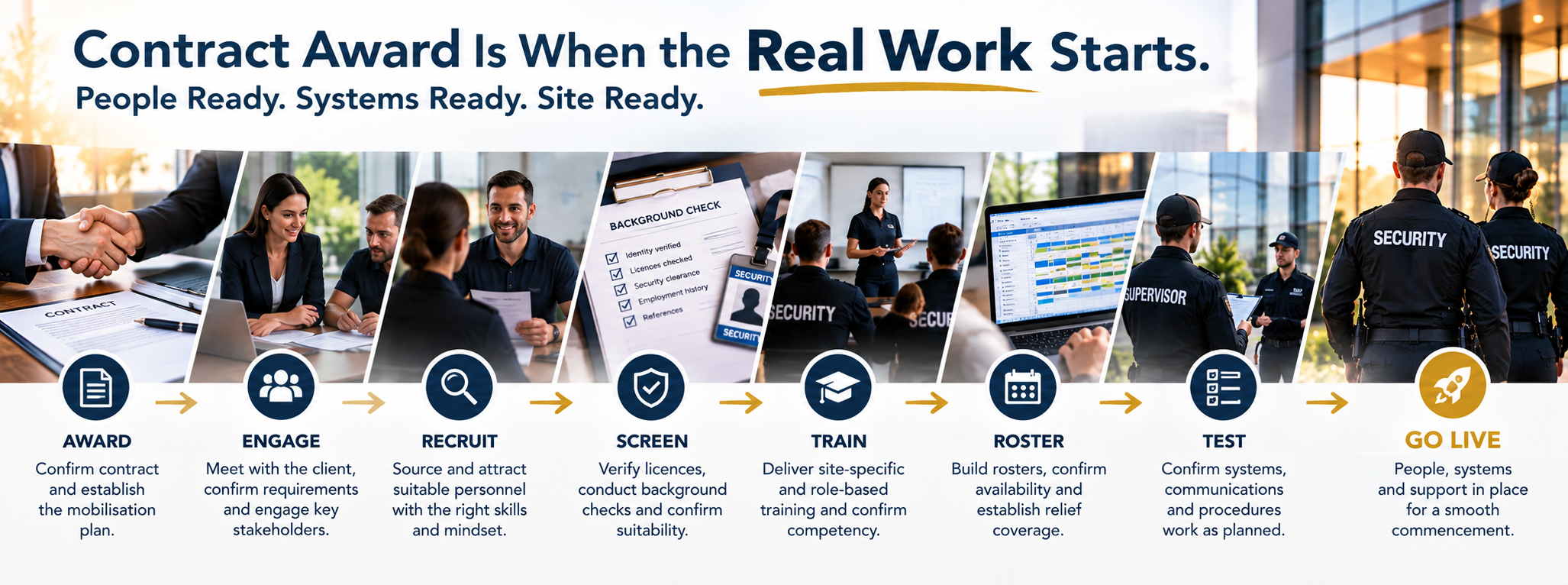
Where incumbent personnel are available, the response can also explain how they will be assessed, engaged and integrated while maintaining appropriate standards and preserving valuable site knowledge.
A good mobilisation plan gives the evaluator confidence that nothing falls into the gap between the old contract and the new one.
Rostering is a Security Control
A roster isn't simply an administrative document showing who works Tuesday night.
It is part of the service delivery system.
Good rostering helps ensure the right competencies are available on every shift, fatigue is managed, supervisory coverage is maintained and vacancies are identified before they become service failures.
For larger contracts, your tender may need to explain:
Roster development.
Shift patterns.
Site competency requirements.
Availability management.
Leave planning.
Relief personnel.
Fatigue controls.
Shift swaps.
Unplanned absences.
Supervisor coverage.
Attendance verification.
Escalation of unfilled shifts.
If you use workforce management technology, we can help demonstrate how it supports the process without turning three pages of the tender into a software brochure.
Training should Prepare Officers for this Site
A security licence gets someone through the gate.
It doesn't necessarily prepare them for your client's environment.
Every site has different risks, people, procedures, systems and expectations.
Site-specific training may cover:
Post orders.
Emergency procedures.
Access control.
Patrol requirements.
Alarm response.
Incident escalation.
Radio protocols.
Customer service.
Site technology.
Contractor management.
Key management.
Sensitive areas.
Reporting requirements.
Client policies and procedures.
Training shouldn't finish at mobilisation either.
Refresher training, toolbox talks, competency assessments, incident learnings and updated procedures can all form part of ongoing contract delivery.
The tender should demonstrate how you know officers are competent - not merely that they've attended an induction.
When something Happens, what Happens Next?
This is where security methodologies become interesting.
An incident rarely consists of:
Incident occurs → security officer deals with it → finished.
There may be assessment, communication, escalation, emergency services, evidence preservation, stakeholder notification, reporting, follow-up and review.
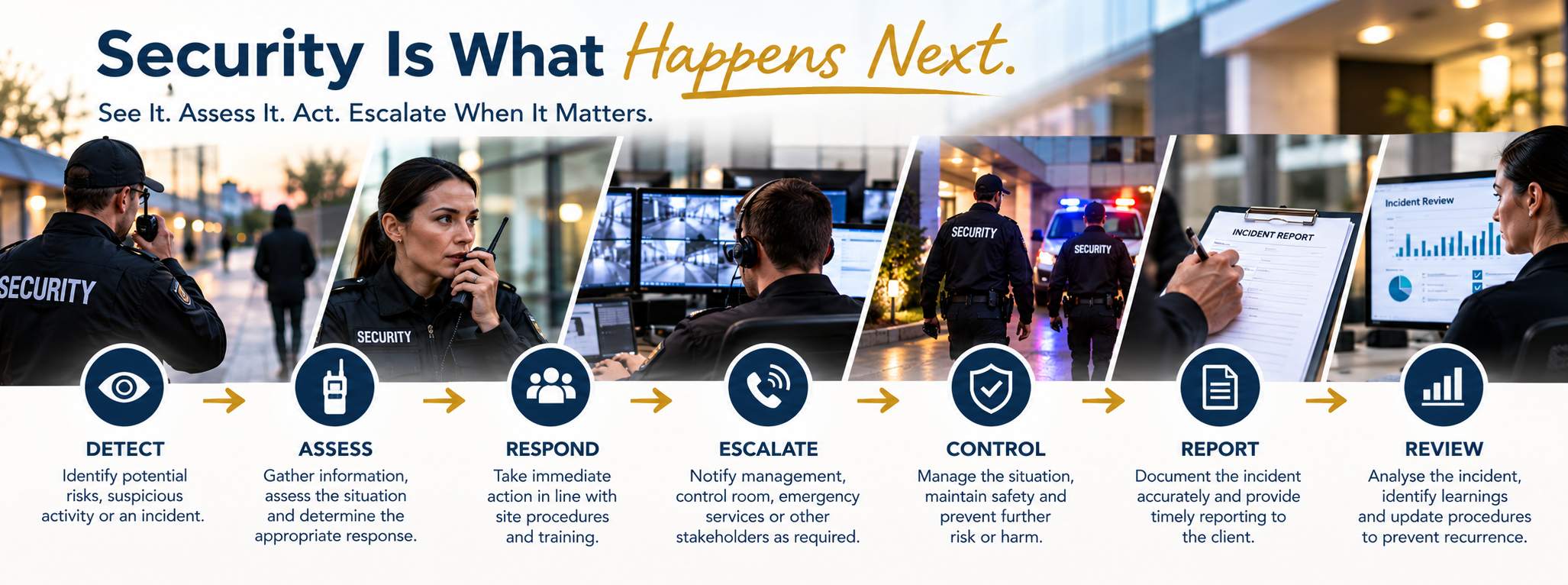
A strong incident methodology might follow:
Detect
Assess
Respond
Escalate
Control
Report
Review
The exact response depends on the incident.
A medical emergency isn't managed like an unauthorised access event.
A protest isn't managed like a fire alarm.
An aggressive person isn't managed like a suspicious package.
We help demonstrate that your people understand when to act, when to escalate and who needs to know.
Control Rooms are the Operational Hub
Where a contract includes control room operations, the control room can become the nerve centre of the security service.
Operators may monitor alarms and CCTV, communicate with officers, coordinate incidents, manage access, receive calls, dispatch patrols and maintain operational records.
Your tender may need to demonstrate:
Operator competency.
Control room procedures.
Alarm management.
CCTV monitoring.
Radio communications.
Incident coordination.
Escalation protocols.
Emergency response.
Shift handover.
Record keeping.
Business continuity.
Technology competency.
This is also where the line between physical and electronic security begins to overlap.
Where a contract involves CCTV, access control, alarm monitoring or integrated security systems, our electronic security tender writing services focus on explaining how the technology, monitoring arrangements, maintenance and response processes work together.
Patrols Need Purpose
“Security officers will conduct regular patrols.”
Fine.
But what are they looking for?
A meaningful patrol methodology can explain how patrols are scheduled, varied where appropriate, verified and documented.
Officers might check:
Doors and windows.
Restricted areas.
Fire exits.
Perimeters.
Lighting.
Unauthorised persons.
Suspicious activity.
Hazards.
Damage.
Plant or equipment.
After-hours activity.
Site-specific risk points.
Technology such as GPS, NFC, QR or checkpoint systems may provide verification, but technology alone doesn't make a patrol effective.
The important part is what the officer observes and what happens when something isn't right.
Security Officers are also Customer-facing People
Security officers aren't always standing at a gate looking intimidating.
Many work at reception desks, building entrances, galleries, universities, government facilities, corporate offices and public venues.
They may be the first person a visitor meets.
That means communication, judgement and professionalism can be every bit as important as traditional security skills.
Your tender may need to demonstrate how officers are selected and trained to:
Welcome visitors.
Provide directions.
Manage difficult interactions.
Communicate calmly.
De-escalate situations.
Assist vulnerable people.
Maintain confidentiality.
Apply procedures consistently.
Exercise appropriate judgement.
Represent the client professionally.
The best security service can be highly visible when it's needed - and almost invisible when it isn't.
Reporting should tell the Client Something Useful
Security operations generate plenty of information.
Incident reports. Patrol records. Alarm activations. Access events. Shift logs. Attendance data. Training records. Complaints. Hazards. Trends.
The question is what you do with it.
Good contract reporting can help identify:
Recurring incidents.
High-risk locations.
Patterns by time or day.
Repeated alarm activations.
Training needs.
Emerging risks.
Service issues.
Opportunities to improve procedures.
Performance against KPIs.
Rather than simply promising monthly reports, a strong tender can explain how operational data becomes useful information for the client.
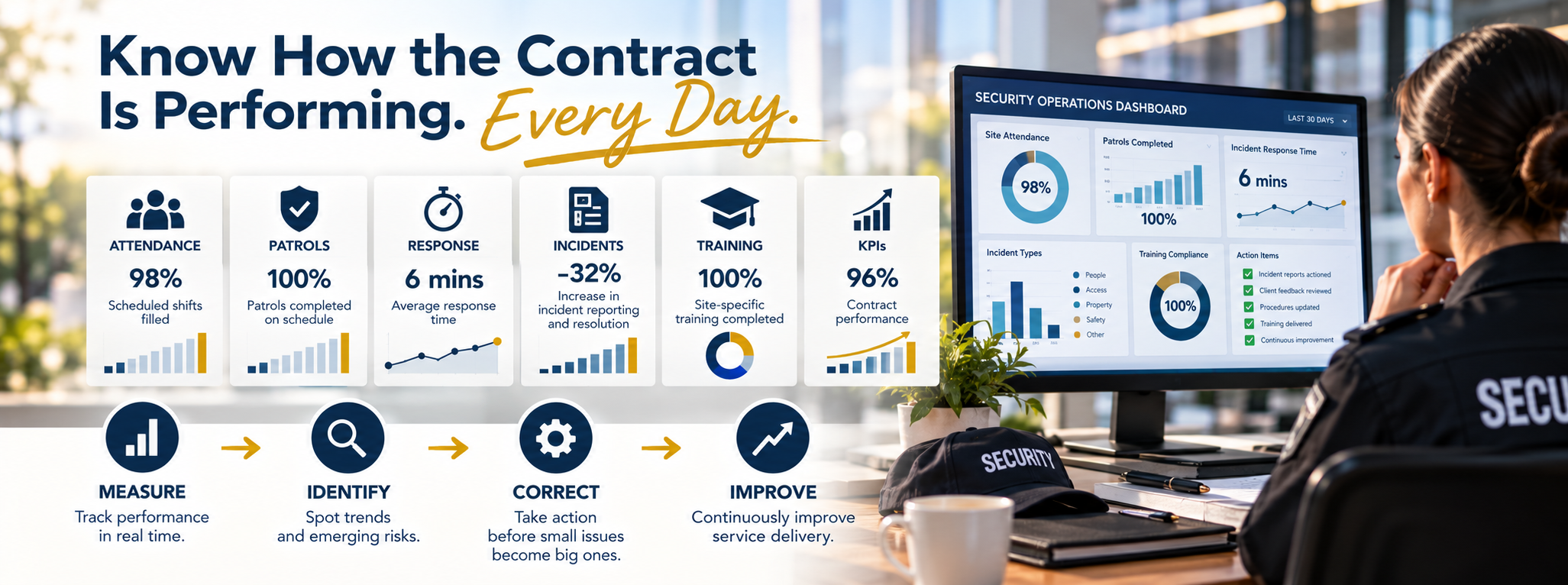
Performance shouldn't be a Surprise at the Monthly Meeting
If the first time you discover a problem is during the monthly contract meeting, the performance management system isn't doing much managing.
Security contracts may be measured against KPIs such as:
Shift fulfilment.
Attendance.
Patrol completion.
Response times.
Training compliance.
Incident reporting.
Customer complaints.
Audit results.
Corrective actions.
Reporting timeliness.
Your methodology can demonstrate how performance is monitored continuously, how exceptions are identified and how corrective action occurs before small problems become recurring ones.
The monthly report should confirm what you already know.
Not reveal it.
Safety Includes your Officers and Everyone Around them
Security personnel can work in environments where situations change quickly.
Risks may include aggression and violence, lone work, fatigue, vehicle movements, slips and trips, emergency incidents, exposure to hazardous environments and interaction with members of the public.
Depending on the contract, we can help develop responses covering:
WHS management.
Site risk assessment.
Working alone.
Fatigue management.
Aggression and violence.
Duress arrangements.
Vehicle safety.
Emergency response.
Incident management.
PPE.
Training and competency.
Officer welfare.
Consultation.
Hazard reporting.
The response should show that officer safety is integrated into how the service is actually delivered.
Business Continuity Matters when Security can't Stop
Some services can wait until tomorrow.
Security often can't.
If a system fails, an officer is unavailable, severe weather affects the site or another disruption occurs, the client still needs a security service.
A business continuity response might explain how you manage:
Staff shortages.
System outages.
Communications failures.
Vehicle breakdowns.
Power failures.
Severe weather.
Major incidents.
Supplier disruption.
Loss of access to normal facilities.
The objective isn't to claim that nothing will ever go wrong.
It's to demonstrate that you've thought about what happens when it does.
Physical and Electronic Security Work Better Together
Modern security increasingly combines people and technology.
CCTV can detect activity.
An alarm can generate an alert.
Access control can identify an event.
But somebody may still need to assess what's happening, make a decision and respond.
Where contracts combine guarding with CCTV, alarms, access control, monitoring or electronic security maintenance, TenderWise can help present the solution as one integrated security operation.
Here’s more information about Electronic Security Tenders.
Government Security Tenders
Government security tenders can be complex, detailed and highly scrutinised.
TenderWise can help security companies develop responses covering:
Corporate capability.
Relevant experience.
Key personnel.
Workforce management.
Recruitment and retention.
Incumbent workforce transition.
Rostering.
Training and competency.
Guarding methodology.
Control room operations.
Mobile patrols.
Incident response.
Emergency management.
Mobilisation and transition.
WHS.
Risk management.
Quality management.
Business continuity.
Contract management.
KPIs and reporting.
Technology.
Sustainability.
Social procurement.
Indigenous participation.
Continuous improvement.
Value for money.
We start by understanding what this particular client needs from its security provider.
Then we help demonstrate how your business will deliver it.
Already Written your Security Tender?
We Can Review It Before You Submit
If you've prepared your tender internally, TenderWise can review it before lodgement.
We'll look for:
Questions that haven't been fully answered.
Requirements buried elsewhere in the tender documents.
Generic security responses.
Unsupported claims.
Missing evidence.
Weak methodologies.
Inconsistencies.
Compliance issues.
Missing attachments.
Gaps between your proposed solution and the specification.
Opportunities to demonstrate capability more clearly.
Presentation and readability.
Security tenders often contain requirements scattered across specifications, schedules, conditions, policies and attachments.
Sometimes the most valuable thing we can do is find the requirement that was sitting quietly on page 87 waiting to ruin your afternoon.
Your Real Advantage may be the Things you do Every Day
Experienced security providers often underestimate how much operational knowledge exists inside their business.
How you fill a vacant shift.
How a supervisor knows an officer hasn't arrived.
How an incident is escalated.
How new officers become site competent.
How information passes between shifts.
How you manage fatigue.
How patrols are verified.
How you respond when demand suddenly increases.
How management knows something isn't working.
To you, those things may simply be how the business operates.
To an evaluator, they're evidence of capability.
Our job is to uncover them and make sure they're in the tender.
Need Help with a Security Tender?
Whether you're tendering for government security services, commercial guarding, mobile patrols, control room operations, concierge security or a complex multi-site contract, TenderWise can help.
Your people. Your systems. Your experience - presented properly.
Clarity. Confidence. Capability. Let's do this!