Concreting Tenders
Concreting Tender Writing for Civil, Commercial and Government Contracts
Concreting tenders come in all shapes and sizes.
You might be tendering for a single commercial project, a council maintenance contract, a civil works panel or a multi-year program covering hundreds of individual work orders.
Depending on the opportunity, you may need to demonstrate experience and capability across:
Footpaths.
Kerb and channel.
Crossovers and driveways.
Concrete pavements.
Slabs and foundations.
Pram ramps and accessibility works.
Traffic islands.
Drainage structures.
Concrete repairs.
Removal and replacement.
Reinstatement works.
Minor civil works.
Streetscape works.
Reactive maintenance.
Programmed maintenance.
Multi-site works.
Work order contracts.
TenderWise helps turn those capabilities into a response that shows the evaluator how your business will deliver their contract.
The Methodology Starts before Anyone Gets on Site
One of the easiest ways to weaken a concreting methodology is to start it with excavation.
A lot has already happened by then.
Before works commence, your team may need to review the work order, inspect the site, confirm quantities and conditions, locate underground services, arrange permits, prepare traffic management, notify affected stakeholders and identify site-specific risks.
For council works, there may also be residents, businesses, pedestrians, cyclists, parked vehicles, existing assets and adjoining properties to consider.
A strong methodology makes that planning visible.
It might follow a sequence such as the one shown below:

The evaluator can see not only what you build, but how you control the work.
Every Site is Different
We understand that a 20-metre section of footpath outside a quiet reserve isn't the same as a footpath outside a shopping strip at school pick-up time.
The construction activity may be similar.
The delivery environment isn't.
That’s why your tender response should demonstrate how site conditions influence the way the work is planned and delivered.
That might include:
Pedestrian volumes.
Traffic conditions.
Property access.
Nearby businesses.
Schools and community facilities.
Public transport.
Existing services.
Trees and vegetation.
Drainage.
Adjacent structures.
Restricted working areas.
Noise constraints.
Other contractors or works.
Rather than describing one fixed methodology for every job, we can help show that you have a consistent process that adapts to the site.
Protecting Access while the Work gets Done
For many council concreting contracts, one of the biggest challenges isn't pouring concrete. It's keeping everyone moving safely while you do it.
Footpaths may need temporary diversions. Driveway access may be interrupted. Residents may need advance notice. Businesses may need continued customer access. Traffic management may be required.
Good communication becomes part of good construction.
Your tender may need to explain how you will manage:
Resident and business notification.
Property access.
Pedestrian diversions.
Traffic management.
Temporary barriers.
Signage.
Disability access.
Work staging.
Out-of-hours requirements.
Unexpected access issues.
Complaints and enquiries.
The objective is to demonstrate that you can deliver the works without creating unnecessary disruption around them.
What Happens under the Concrete Matters
The finished surface is what everyone sees.
The evaluator also wants confidence in everything underneath it.
Depending on the work, your methodology may need to cover excavation, subgrade assessment, preparation and compaction, bedding materials, formwork, reinforcement, dowels, levels, falls, drainage interfaces and pre-pour inspections.
This is where generic statements such as:
“Works will be undertaken in accordance with the specification.”
don't tell the evaluator very much.
We help explain how your team controls the critical stages of the work, including the points at which work is checked before the next activity proceeds.
Quality Doesn't Start with the Final Inspection
By the time concrete has cured, some quality problems are considerably harder to fix.
That's why quality control needs to happen throughout delivery.
Depending on the project and specification, controls might include:
Set Out → Prepare → Check → Form → Reinforce → Pre-Pour Check → Place → Finish → Cure → Inspect
Your tender response can explain who performs inspections, what is checked, what records are retained and what happens if something doesn't meet requirements.
Quality evidence might include:
Inspection and test plans.
Hold and witness points.
Pre-pour inspections.
Delivery dockets.
Concrete test results.
Photographs.
Work order records.
Defect registers.
Completion inspections.
As-constructed information.
The important part isn't simply having forms.
It's showing how your quality system prevents problems and verifies the finished work.

Concrete Delivery Is a Coordination Exercise
Once the pour starts, you don't want half the pieces of the puzzle still wandering around looking for each other.
People, plant, concrete supply, access, traffic management and weather conditions all need to line up.
For larger programs, this becomes a scheduling and resource management issue as well as a construction one.
Your tender may need to demonstrate how you:
Program multiple work sites.
Allocate crews and supervisors.
Coordinate concrete suppliers.
Manage plant and equipment.
Sequence works geographically.
Respond to weather.
Manage urgent works.
Reschedule delayed activities.
Coordinate subcontractors.
Maintain productivity across concurrent sites.
We can help turn that operational knowledge into a methodology that demonstrates capacity as well as capability.
Work Orders need to Keep Moving
Council maintenance contracts can involve a steady stream of individual work orders rather than one traditional construction program.
That requires a different approach.
The contractor needs to know what has been received, what has been inspected, what's scheduled, what's underway, what's waiting on something else and what's complete.
A simple contract workflow might be:

Your tender can explain how work orders are allocated, prioritised, tracked and closed - and how the client gets visibility over progress.
For high-volume contracts, that management system can be just as important as the physical works.
Safety needs to Look like Concreting
Saying you have a commitment to providing a safe workplace isn't a methodology.
Concreting and minor civil works can involve excavation, mobile plant, concrete trucks, saw cutting, silica exposure, manual handling, underground services, traffic, pedestrians, reinforcement, formwork, hazardous substances and interaction with members of the public.
Depending on the tender, we can help develop responses covering:
WHS management.
Site-specific risk assessment.
SWMS.
Underground services.
Silica controls.
Excavation.
Mobile plant.
Traffic management.
Pedestrian management.
Manual handling.
Concrete cutting.
PPE.
Public protection.
Emergency response.
Incident reporting.
Training and competency.
Subcontractor management.
The response should demonstrate that your controls are based on the risks associated with the actual work.
Environmental Management Without the Green Waffle
Concreting has very real environmental risks.
Concrete slurry and washout don't belong in a stormwater drain. Neither does sediment from excavation.
A practical environmental methodology might cover:
Concrete washout.
Slurry containment.
Sediment controls.
Stormwater protection.
Dust.
Noise.
Waste concrete.
Excavated material.
Recycling.
Fuel and chemical storage.
Spill response.
Vegetation protection.
Site reinstatement.
Where your business recycles concrete, separates waste, reuses suitable materials or takes other practical steps to reduce waste, those are worth explaining.
Specific actions are far more persuasive than promising to “minimise our environmental footprint wherever practicable”.
Show what you do.
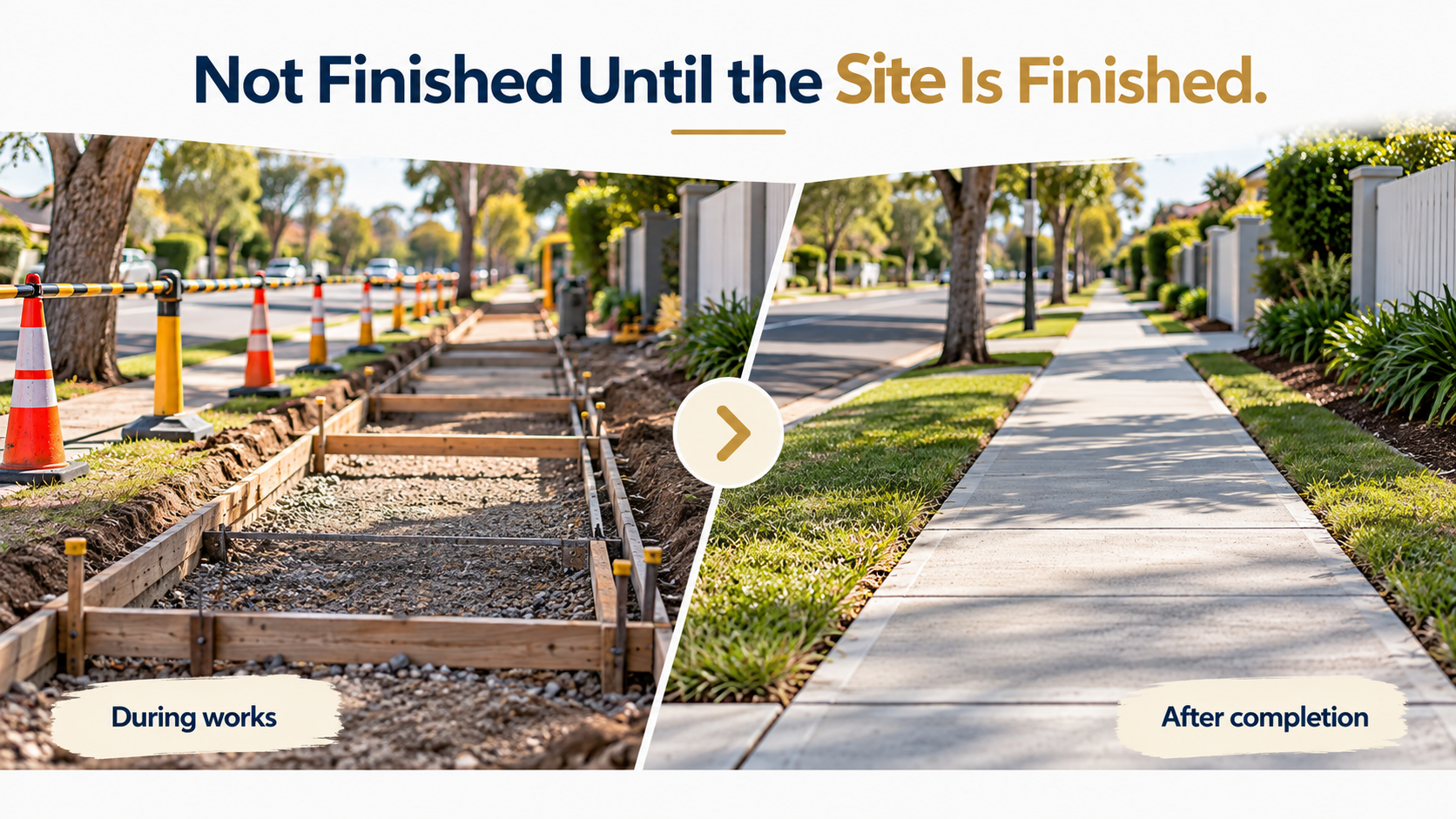
Reinstatement is Part of the Job
Finishing the concrete doesn't necessarily mean the work is finished.
Surrounding areas may need to be reinstated, cleaned and made safe.
That could include topsoil and turf, asphalt, pavers, landscaping, line marking, adjoining surfaces or other disturbed areas.
Temporary barriers and controls may also need to remain until the concrete has achieved sufficient strength.
A good tender methodology takes the job right through to final inspection, clean-up, reinstatement and handover.
Because leaving behind a beautiful new footpath surrounded by a construction mess isn't much of a finish.
Defects are about what Happens Next
Nobody wins points in a tender by pretending defects can never happen.
What matters is having a system for identifying, recording and rectifying them.
Your response might explain how defects are:
Identify → Record → Assess → Rectify → Reinspect → Close
It can also demonstrate how recurring issues are reviewed to determine whether something needs to change in materials, workmanship, supervision or process.
That turns defect management from a reactive activity into part of continuous improvement.
Your People and Equipment Matter
Evaluators may want confidence that you have enough people, plant and equipment to deliver the proposed workload.
That doesn't mean dumping an equipment register into the methodology.
It means connecting your resources to the contract.
Depending on the tender, we can help demonstrate the availability and relevance of:
Project and contract managers.
Supervisors and leading hands.
Concreters.
Labourers.
Plant operators.
Traffic management personnel.
Subcontractors.
Excavators.
Trucks.
Concrete saws.
Compaction equipment.
Formwork equipment.
Small plant and tools.
Where multiple crews are available, the response can also explain how resources are scaled to meet changing workloads or concurrent programs.
Mobilisation: Ready before the First Work Order
For an ongoing council or government contract, mobilisation needs more than a start date.
The period between contract award and commencement is where you establish the systems, people and arrangements needed for delivery.
That might include:
Contract kick-off.
Confirmation of key personnel.
Staff and subcontractor inductions.
System configuration.
Work order processes.
Site familiarisation.
Plant and equipment allocation.
Supplier confirmation.
Traffic management arrangements.
Communication protocols.
Reporting templates.
WHS documentation.
Environmental controls.
Quality documentation.
Emergency contacts.
A clear mobilisation plan gives the evaluator confidence that Day One has been thought through before Day One arrives.
Government and Council Concreting Tenders
Councils and government agencies procure concreting services in many different ways - individual projects, annual maintenance contracts, schedules of rates, supplier panels and broader civil works arrangements.
TenderWise can help develop responses covering:
Relevant experience.
Organisational capability and capacity.
Service delivery methodology.
Work programming.
Work order management.
Key personnel.
Plant and equipment.
Traffic and pedestrian management.
Community engagement.
WHS.
Quality management.
Environmental management.
Risk management.
Mobilisation.
Business continuity.
Contract management.
KPIs and reporting.
Subcontractor management.
Social procurement.
Local participation.
Sustainability.
Value for money.
Continuous improvement.
We don't start with a generic concreting template and try to make the tender fit it.
We start with the tender.
Already Written Your Concreting Tender?
We Can Review It Before You Submit
If you've prepared the response yourself, TenderWise can provide an independent review before lodgement.
We'll look for things such as:
Questions that haven't been completely answered.
Requirements buried in specifications or contract documents.
Generic methodologies.
Missing evidence.
Unsupported claims.
Inconsistencies.
Compliance issues.
Missing attachments.
Weak project examples.
Opportunities to demonstrate capability more clearly.
Presentation and readability.
Sometimes the difference isn't writing another five pages.
It's spotting the five things the evaluator needed to know that never made it into the first draft.
Your Experience is Probably more Valuable than you Think
Experienced concreting contractors often do things automatically because they've been doing them for years.
You know when access is going to become a problem.
You know what needs checking before the pour.
You know how to sequence a program so crews aren't wasting half the day travelling between jobs.
You know when a site needs additional traffic control.
You know how to deal with a resident who desperately needs their driveway back.
You know what can go wrong - and how to prevent it.
Those things aren't just “how we normally do the job”.
They're evidence of capability.
Our job is to get that knowledge out of your head and into the tender.
Need Help with a Concreting Tender?
Whether you're tendering for council footpath works, kerb and channel, concrete maintenance, civil works, a government panel or a commercial concreting project, TenderWise can help.
Your trade. Your experience. Your capability - presented properly.