

Professional Services and Consultancy Tender Writing
Expertise gets you to the Table. Your Tender needs to do More.
Professional services tenders can be deceptively difficult.
You may have highly qualified people, decades of experience and an impressive portfolio of work. The problem is that many of your competitors do too.
When an evaluator is comparing several credible firms, simply demonstrating that you can deliver the work isn't enough. Your tender needs to make it easy to understand why your team, your approach and your experience are particularly relevant to this opportunity.
TenderWise helps professional services firms turn their expertise into clear, persuasive tender responses that demonstrate capability without drowning the evaluator in corporate language.
Whether you're responding to government tenders, council opportunities, universities, major organisations or the private sector, we help you get beyond "we are an experienced team committed to delivering high-quality outcomes" and explain what actually makes your offer compelling.
Professional services companies typically have high standards themselves, and the quality of competing submissions often reflects that.
Professional Services Tenders are Selling Confidence
Professional services are often intangible.
You're not tendering to supply 500 chairs or resurface 10 kilometres of road. You're asking the buyer to trust your people, judgement, expertise and ability to deliver an outcome that may not exist yet.
That means your tender may need to demonstrate:
Relevant organisational experience.
Qualifications and specialist expertise.
Proposed personnel and availability.
Understanding of the client's requirements.
Methodology and approach.
Project and contract management.
Stakeholder engagement and communication.
Quality assurance.
Risk management.
Governance and reporting.
Innovation and continuous improvement.
Social and sustainable procurement.
Value for money.
Relevant project outcomes and client references.
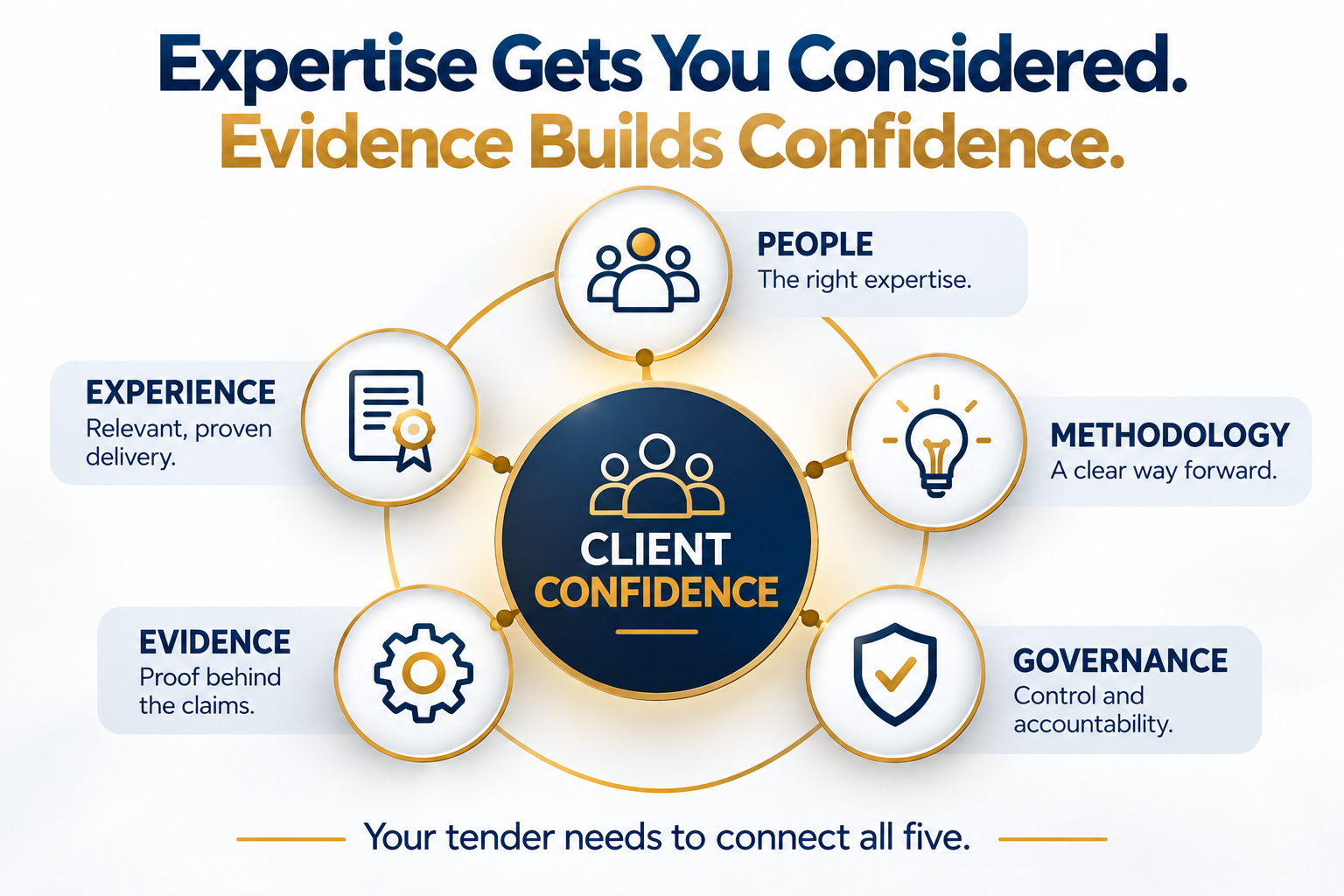
The strongest responses don't treat these as isolated criteria.
Together, they tell one story:
We understand what you need, we've done comparable work before, these are the people who will deliver it, and this is how we'll achieve the outcome.
Your Methodology shouldn't Sound like Everybody Else's
This is one of the biggest problems we see in professional services tenders.
Methodologies can quickly become a collection of phrases such as collaborative approach, best-practice methodology, tailored solution, proactive communication and commitment to excellence.
None of those things is necessarily wrong.
They're just very difficult to evaluate.
A stronger methodology explains what will actually happen.
How will the project start?
How will information be gathered?
Who will make decisions?
How will stakeholders be consulted?
How will risks and issues be identified and escalated?
What will the client receive at each stage?
How will quality be checked?
How will progress be measured?
We help turn broad promises into a clear delivery approach the evaluator can picture in practice.
It’s no Surprise that your People are your Strongest Differentiator
In professional services tenders, the proposed team can be just as important as the organisation behind them.
But a collection of impressive CVs isn't enough.
The evaluator needs to understand why these particular people are right for this particular assignment.
That means connecting qualifications and experience directly to the scope.
Rather than:
Jane has 18 years' industry experience.
The useful question is:
What has Jane done during those 18 years that reduces risk or adds value to this client?
We help draw those connections through personnel profiles, project examples, role descriptions and CVs so the tender presents a team with a clear purpose - not simply a list of impressive biographies.
Relevant Experience is more than a List of Projects
A project isn't relevant just because it happened in the same industry.
Good tender responses explain the connection.
What was the scope?
What challenges were involved?
What did your team actually deliver?
Which members of the proposed team were involved?
What outcomes were achieved?
What did you learn that will benefit this client?
Where possible, we look for measurable evidence - timeframes achieved, cost outcomes, performance results, stakeholder outcomes, repeat appointments, contract extensions or other evidence of successful delivery.
The result is a project example that demonstrates capability rather than simply occupying half a page.

Understanding the Client can make or Break the Response
One of the easiest ways to produce an ordinary professional services tender is to spend the entire response talking about yourself.
The evaluator already knows you're interested in the contract.
What they want to know is whether you understand their objectives, risks, constraints and priorities.
A strong response connects your solution to the client's environment.
That may mean recognising stakeholder sensitivities, operational constraints, governance requirements, regulatory obligations, time pressures, budget considerations or dependencies with other projects and providers.
This is where research, careful reading of the tender documents and good questioning become particularly important.
Your methodology shouldn't merely describe how you normally work.
It should demonstrate how you intend to work for this client.
Good Governance doesn't Need to be Complicated
Professional services tenders frequently ask about project management, governance, communication, reporting, risk and quality.
The temptation is to create an elaborate management structure because it looks impressive on paper.
Usually, clarity is more persuasive.
The evaluator should be able to see clear accountability:
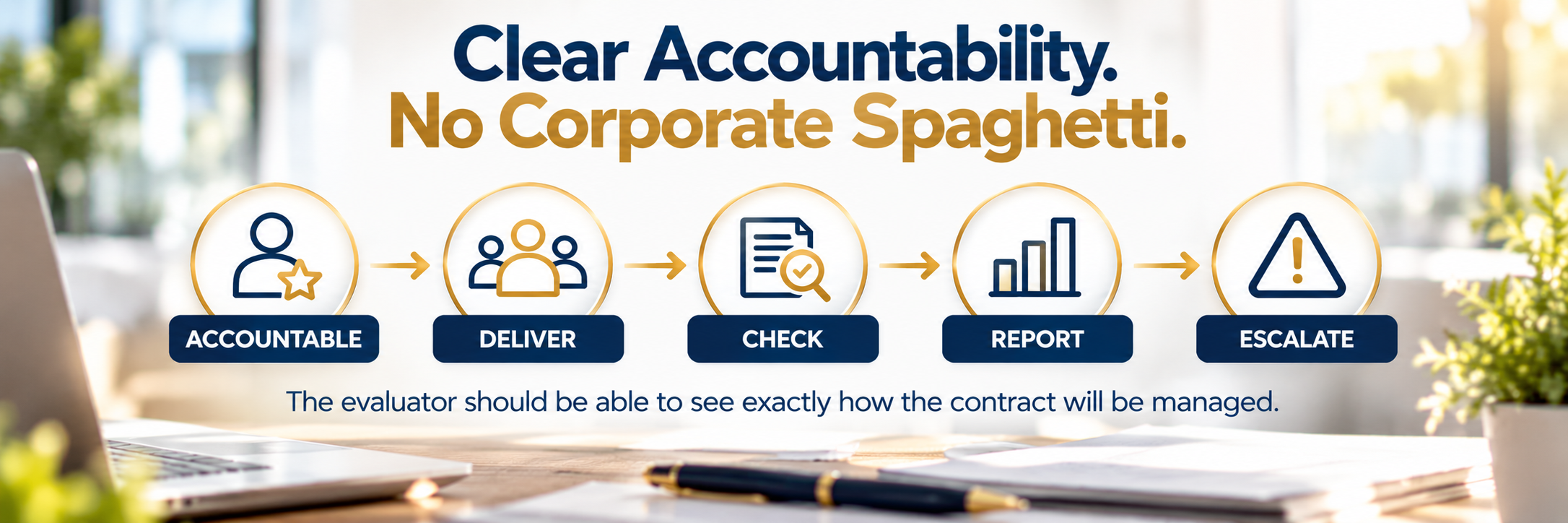
We can help develop a governance model that clearly explains responsibilities, communication pathways, decision-making, reporting and escalation without turning a straightforward contract into a multinational peacekeeping operation.
Don't just say you Collaborate. Show how.
"We will work collaboratively with the client and key stakeholders."
Perfectly reasonable.
Also said in approximately every professional services tender ever written.
A better response explains how collaboration actually happens.
That might involve commencement workshops, stakeholder mapping, agreed communication protocols, regular progress meetings, consultation activities, decision registers, shared project systems, feedback loops and defined escalation processes.
The detail depends on the assignment.
The principle doesn't:
If something matters to the evaluation, demonstrate it rather than simply describing yourself as good at it.
Risk Management should be Specific to the Assignment
Generic risk registers rarely add much value.
A professional services tender becomes more credible when it identifies the things that could genuinely affect successful delivery.
Perhaps stakeholder availability could delay consultation.
Perhaps information supplied by third parties may be incomplete.
Perhaps approvals are dependent on another agency.
Perhaps several workstreams need to converge before a critical milestone.
Perhaps key personnel continuity is particularly important.
Identifying realistic risks - and showing practical controls - demonstrates that you've thought about the assignment before winning it.
Value for Money Isn't the Same as Lowest Price
Professional services procurement often requires buyers to balance price with expertise, methodology, risk and expected outcomes.
Your tender should help the evaluator understand the value behind your price.
That might include senior personnel involvement, specialist expertise, efficient systems, reduced delivery risk, knowledge transfer, continuity of personnel, reusable tools, streamlined reporting or an approach that reduces demands on the client's own team.
Rather than simply claiming to offer value for money, we help identify where that value actually comes from.
Make your Evidence do some Work
Claims are easy to write.
Evidence is harder to ignore.
If you say you're experienced, show comparable assignments.
If you say clients trust you, provide repeat engagements or references.
If you say your methodology works, demonstrate where you've used it successfully.
If you say your team is responsive, provide evidence of how responsiveness is managed.
If you say you deliver quality outcomes, explain how they're checked and give examples.
A good tender doesn't need to shout.
It needs to make its claims believable.
Tell us how you Really Work
Some of the most useful information we uncover when writing professional services tenders isn't sitting in a capability statement.
It comes from asking questions.
What happens when a project starts going off track?
Who is the person the client actually calls?
How involved will the director named in the tender really be?
What does your team do differently from your competitors?
Why did that client come back for another project?
What went wrong on a previous assignment - and what did you change because of it?
How do you stop a junior team member's work going to the client unchecked?
What do your best clients value about working with you?
Those conversations help us uncover the details that make your tender sound like your business, rather than every other consultancy bidding for the work.
You know your profession.
Our job is to help the evaluator understand why they should have confidence in you.
Need help with a Professional Services Tender?
TenderWise can prepare your complete tender response or review and strengthen a submission you've prepared yourself.
We work with you to understand the opportunity, your team, your experience and the way you actually deliver your services, then turn that information into a clear, credible and persuasive response.
You know your business. We know how to showcase your capability.
Clarity. Confidence. Capability. Let’s do this!