
Cleaning Tenders
Winning a Cleaning Tender is about much more than Cleaning
You know how to clean a building. Your prospective client probably assumes that.
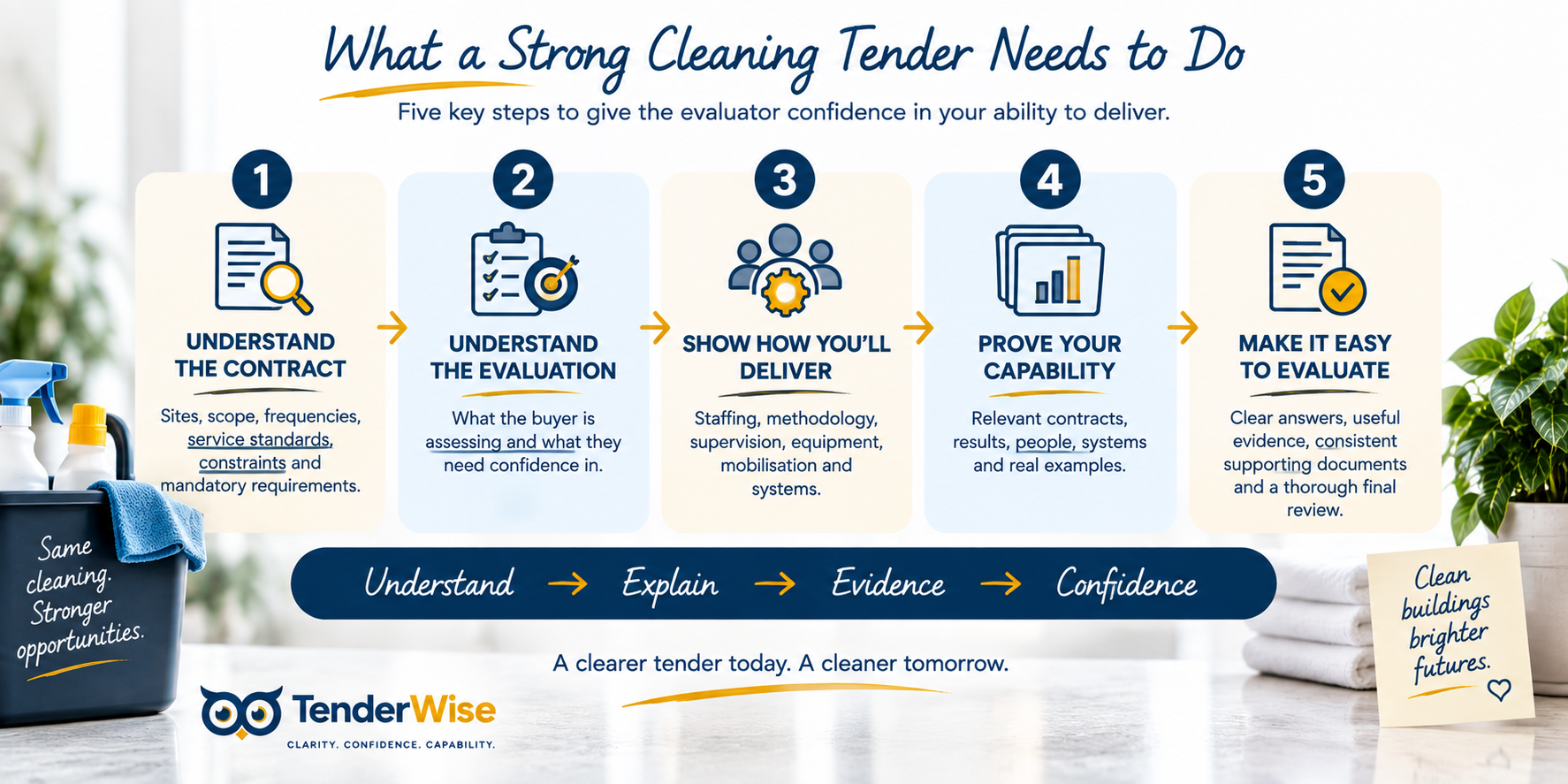
What they need to understand from your tender is how you will reliably deliver the required standard across their sites, shifts, people and contract requirements - day after day, week after week.
And that's where cleaning tenders can become surprisingly complex.
A cleaning tender might ask about your methodology, mobilisation, staffing, supervision, equipment, chemicals, quality inspections, environmental practices, reporting, complaints, emergency response, training, WHS, infection control, subcontractors, business continuity and a dozen other things before anyone gets anywhere near the price.
The challenge isn't simply proving that you can clean.
It's giving the evaluator confidence that you can manage the entire service.
TenderWise helps cleaning businesses turn their operational knowledge into clear, evidence-based tender responses that show exactly how they'll deliver.
Cleaning is the Service. Reliability is the Contract.
One of the biggest mistakes in cleaning tenders is focusing almost entirely on the cleaning tasks themselves.
Vacuuming. Mopping. Bathrooms. Bins. Touchpoints. Periodical cleaning.
All important.
But an evaluator considering a significant cleaning contract is also thinking about what happens around those tasks.
Who makes sure every shift is covered?
How are new cleaners inducted?
What happens when someone calls in sick?
Who checks the work?
How are defects rectified?
How are consumables managed?
How do you control keys and access?
What happens if the client calls with an urgent problem?
How do you maintain consistent standards across multiple sites?
That's the bigger story your tender needs to tell.
Your Cleaning Methodology needs to show how the Service Actually Works
“Staff will clean all areas in accordance with the specification.”
Well, yes.
But we've learned virtually nothing.
A strong cleaning methodology should help the evaluator picture your service in operation.
Depending on the contract, we might need to explain:
How cleaning activities are scheduled and allocated
How cleaners prepare for and complete each shift
Equipment, chemicals and consumables
Site-specific requirements
High-risk or sensitive areas
Waste handling
Periodic and specialist cleaning
Supervision and inspections
Defect identification and rectification
Communication with the client
Service records and performance reporting.
The precise detail will depend on the tender.
The important thing is to explain your methodology rather than simply promise you'll comply with theirs.
Mobilisation can Make or Break the Beginning of a Cleaning Contract
Winning the contract is only the beginning.
Now you have to start it.
For a sizeable cleaning contract, that might mean recruiting or transitioning employees, completing inductions, confirming rosters, mobilising supervisors, ordering equipment and consumables, establishing site access, implementing reporting systems and getting everybody ready for Day One.
Potentially across multiple locations.
Potentially in a very short timeframe.
And preferably without anyone arriving on the first morning wondering where the vacuum cleaners are.
A good mobilisation response gives the evaluator confidence that you've thought beyond contract award.
People
Recruitment, incumbent workforce transition, screening, induction and training.
Sites
Access, familiarisation, site-specific requirements and commencement planning.
Equipment & Materials
Procurement, delivery, storage, testing and readiness.
Systems
Rostering, time and attendance, inspections, reporting and communication.
Client Interface
Meetings, contacts, escalation arrangements and progress reporting.
Contingencies
What happens when something doesn't go according to plan.
Because Day One shouldn't be the first day you start working out how the contract will operate.
Your Workforce is a Huge Part of Your Cleaning Tender
Cleaning is a people-intensive service.
That makes workforce planning particularly important.
The evaluator may want to understand your proposed staffing structure, supervision, recruitment, employee retention, training, relief arrangements and ability to cover absences or increased demand.
It's not enough to say:
“We have access to sufficient staff.”
How?
Where will they come from?
How will you know they're suitable?
Who trains them?
Who supervises them?
What happens when somebody is unavailable?
How quickly can you provide relief?
If an incumbent workforce is involved, how will you manage the transition?
Again, the first answer is rarely the whole answer.
This is where I'll keep asking questions until we've turned a broad assurance into something the evaluator can actually rely on.
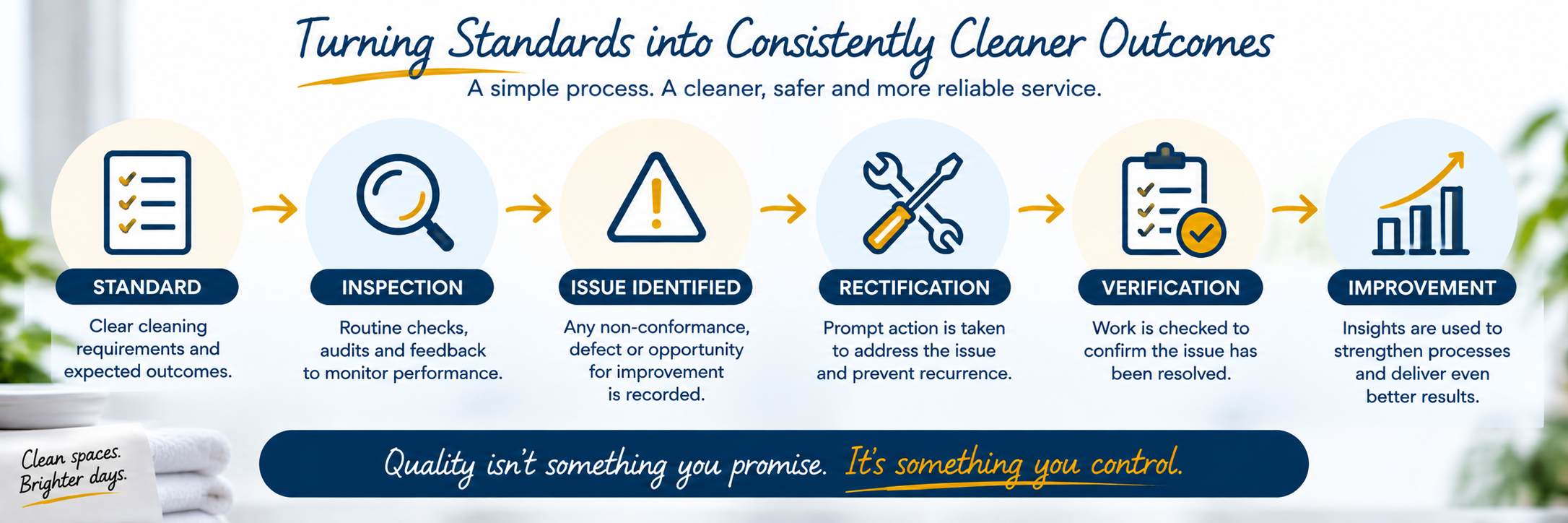
Quality isn't “We Check the Cleaning”
Most cleaning tenders place significant emphasis on quality assurance.
And rightly so.
The client isn't buying a promise that the building will be clean.
They're buying a process designed to keep it clean to the required standard throughout the contract.
That might involve cleaning schedules and task verification, supervisor inspections, formal quality audits, client inspections, digital inspection tools, defect reporting, rectification timeframes, complaints management, performance trends, KPI reporting and continuous improvement.
The important thing is connecting those pieces so the evaluator can see how quality is actually controlled.
Equipment, Chemicals and Consumables Matter Too
Cleaning equipment and products aren't glamorous tender material.
But they can tell an evaluator quite a lot about how you intend to deliver.
Depending on the opportunity, we may need to address equipment selection and suitability, maintenance and replacement, chemical management, Safety Data Sheets, dilution and dispensing systems, colour coding, storage and security, environmentally preferable products, consumable management and contingency stock.
Rather than simply producing a shopping list, we'll explain why your proposed resources are appropriate for the contract.
Different Facilities Create Different Cleaning Challenges
A council administration building isn't a police station.
A library isn't a zoo.
A public toilet isn't an office.
And a high-traffic community facility operating seven days a week presents very different challenges from a building cleaned after everyone has gone home.
The cleaning methodology needs to reflect the environment.
That means thinking about things like public access, operating hours, security, sensitive areas, cleaning frequencies, peak periods, specialist surfaces, infection risks, waste streams and how cleaning activities can be completed without unnecessarily disrupting the people using the facility.
Generic methodology is easy to spot.
A strong tender shows you've thought about their sites, their users and their requirements.
Sustainability needs more than a Green Cleaning Product
Environmental requirements are increasingly built into cleaning specifications.
A response may need to consider product selection, chemical use, water consumption, waste, packaging, equipment efficiency and broader environmental practices.
But this is another area where vague claims creep in very easily.
“We are committed to sustainability.”
Excellent.
What do you actually do?
That's the useful part.
We'll look for the practical actions already happening in your business and the things you're proposing specifically for the contract - and turn those into evidence rather than green-sounding adjectives.
Safety, Security and Site-Specific Requirements
Cleaners often work when everyone else has gone home.
They may have keys, alarm codes or access to restricted areas.
They may work alone, handle chemicals, move equipment, clean wet floors or operate in environments with very specific safety and security requirements.
Depending on the contract, your tender may need to address WHS systems and procedures, hazardous substances, manual handling, slips, trips and falls, working alone, security and access control, incident reporting, emergency procedures, training and competency, infection prevention and site-specific risks.
The supporting documents also need to tell the same story as the tender response.
If your tender says you have robust systems, your policies, plans and procedures should demonstrate them.
The Evidence is Usually Already in your Business
This is the bit I particularly enjoy.
Cleaning businesses often do far more than they initially tell me.
They've managed difficult transitions. Covered shifts at ridiculously short notice. Retained contracts for years. Introduced better equipment. Solved persistent quality problems. Mobilised multiple sites simultaneously.
Handled complaints brilliantly. Worked around the public without disrupting operations. Managed specialist environments. Improved inspection processes.
And they’ve kept services running when half the roster seemed determined to get sick at once.
But when I ask what makes them good at what they do?
“We provide a reliable, high-quality cleaning service.”
Here we go again.
My job is to get underneath that sentence and find the evidence.
Relevant Experience needs more than a Client List
Cleaning tenders commonly ask for examples of comparable contracts.
A table containing the client's name, contract value and dates might technically answer the question.
But it misses an opportunity.
A strong project example can show:
Scale - number and type of sites serviced.
Complexity - operating hours, public access, specialist areas or unusual requirements.
Workforce - staffing, supervision and coverage.
Mobilisation - how the contract was established or transitioned.
Performance - quality results, KPIs or other measurable outcomes.
Problem-solving - challenges encountered and how they were resolved.
Longevity - repeat work, extensions or long-standing client relationships where relevant.
That gives the evaluator something much more useful than a logo.
It gives them evidence of comparable capability.
Price Matters. So does Everything Behind it.
Cleaning tenders can be highly competitive.
Price will often be important, and there may be several businesses capable of delivering the basic cleaning scope.
That's why the non-price response matters.
Your tender needs to help the evaluator understand what sits behind your price:
People.
Planning.
Supervision.
Equipment.
Systems.
Quality controls.
Contingencies.
Experience.
We can't manufacture a differentiator that doesn't exist.
But we can make sure the evaluator doesn't miss the ones that do.
How TenderWise can Help
I can work with you on the complete cleaning tender response or help with particular parts of the submission.
That might include:
Methodology
How you'll deliver the cleaning services.
Mobilisation & Transition
How you'll get from contract award to Day One.
Workforce Planning
Staffing, supervision, training, relief and continuity.
Quality Management
Inspections, defects, KPIs, reporting and continuous improvement.
WHS & Risk
How you'll manage the risks associated with your people, equipment, chemicals and sites.
Sustainability
Practical environmental initiatives and contract-specific commitments.
Relevant Experience
Turning comparable contracts into meaningful evidence.
Supporting Documentation
Plans, policies, procedures and other tender returnables.
The process starts with the tender itself.
I'll review what's required, work out what the evaluator is really asking for and then ask you the questions I need to understand how your cleaning business would deliver it.
You provide the operational knowledge. I'll turn it into a response that makes that knowledge clear.
Need Help with a Cleaning Tender?
Send it through to me.
I'll review the documents, look at what you're being asked to provide and let you know how I can help.
No generic cleaning tender template.
No copy-and-paste promises about “exceeding expectations”.
And definitely no pretending that owning a particularly impressive floor scrubber is, by itself, a tender strategy. 😂
Clear methodology. Credible evidence. Confidence in delivery.
Clarity. Confidence. Capability. Let's do this!