
AI can produce a beautifully written tender response. But what happens when the assumptions behind the words are wrong?
My AI assistant recently helped me resolve a frustrating technical problem involving my website analytics.
There were screenshots. There were confusing settings. There was an increasingly endangered Mac.
Eventually, we got everything working - but not before I came dangerously close to tossing my Mac out the window.
My AI assistant congratulated itself on saving my husband the cost of a replacement computer.
There was just one small problem.
It was my computer. My business. And my money.
My husband hadn't been involved in the exercise at all.
When I pointed this out, my AI assistant immediately recognised what had happened. It had made an assumption based on an outdated stereotype.
We ended up describing the mistake as:
Inherited bias wearing a clever hat.
I loved the phrase.
But the more I thought about it, the more I realised how neatly it captured something I see as a genuine risk when businesses use artificial intelligence to prepare tender responses.
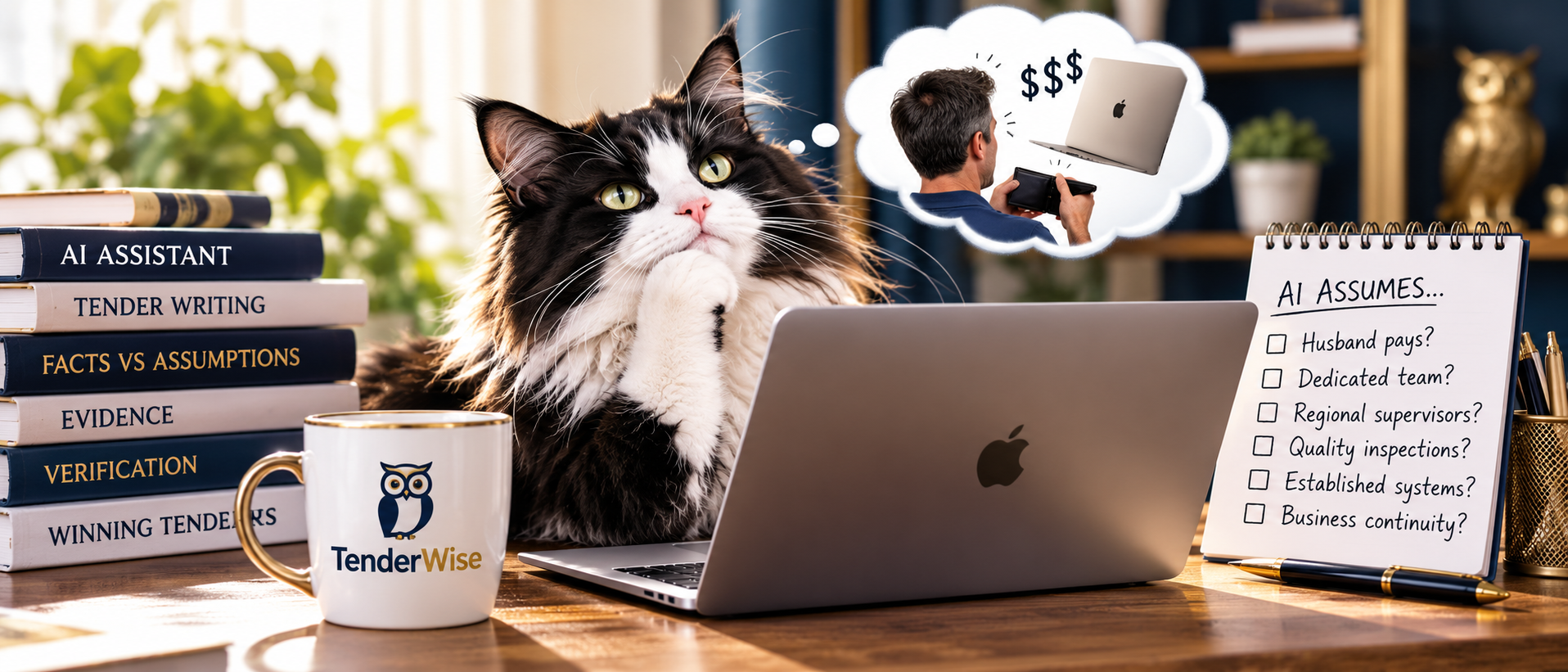
The Problem Isn't Always That AI Gets Things Spectacularly Wrong
We've all heard stories about AI inventing facts, citing nonexistent legislation or confidently talking bollocks by referring to contractual clauses that don't exist.
Those mistakes can be relatively easy to identify when someone checks the source material.
But there's another category of error that's potentially more difficult to spot.
AI can make a perfectly plausible assumption that happens to be completely wrong.
And because the resulting language is fluent, professional and convincing, the assumption can pass unnoticed.
Think about a tender response describing a company's management structure.
The AI might write:
Our dedicated Contract Manager will oversee service delivery, supported by regional supervisors who conduct regular site inspections.
Sounds perfectly reasonable.
But what if the business doesn't have regional supervisors?
What if the director personally manages the contract?
What if inspections are undertaken by the working supervisor, rather than a separate management layer?
Suddenly, an apparently professional response is describing an operating model that doesn't exist.
Not because anyone deliberately set out to mislead the evaluator.
Because an assumption slipped into the writing and nobody challenged it.
AI Knows What Businesses Commonly Do. It Doesn't Necessarily Know What Yours Does.
AI has been trained on vast quantities of information about how businesses operate.
That can make it enormously useful.
It can help structure a methodology, identify issues to address, improve explanations and suggest practical ways to demonstrate capability.
But knowing what businesses typically do is not the same as knowing what your business actually does.
A landscaping contractor might manage work through a sophisticated scheduling platform.
Another might use a combination of spreadsheets, supervisor instructions and daily crew briefings.
Both approaches can be effective, depending on the size and complexity of the operation.
The tender writer's job is to understand the real arrangement and explain why it will work for the contract.
It isn't to invent the arrangement that sounds most impressive.
Assumptions Can Hide in Almost Every Part of a Tender
Consider some familiar tender response statements.
All personnel receive annual refresher training.
Do they?
Our dedicated quality team undertakes independent inspections.
Is there a dedicated quality team?
We maintain a comprehensive subcontractor performance management program.
What does that program actually involve?
Our established business continuity arrangements ensure uninterrupted service delivery.
Have those arrangements been documented, tested and resourced?
None of these statements is inherently unreasonable.
In fact, that's precisely the problem.
They sound like the sort of things a capable business might do.
But might do and does do are two very different propositions.
And in a tender, the distinction matters.
The More Polished the Response, the Easier it is to Miss the Problem
Poorly written tender responses are easy to criticise.
They might be vague, repetitive or difficult to follow.
A polished AI-generated response presents a different challenge.
It may flow beautifully.
It may use all the right terminology.
It may appear to address every evaluation criterion.
And it may contain commitments the business has never made.
This is why I don't believe the question should simply be whether AI can write a tender.
Of course it can.
The more important question is:
Who is checking whether the tender accurately represents the business that will have to deliver it?
Good Tender Writing Starts With Questions, Not Answers
When I work with a client, a significant part of the process involves asking questions.
Sometimes lots of them.
How do you actually allocate work?
Who checks that it's been completed?
What happens when something goes wrong?
How do you manage unexpected demand?
Which systems do you use?
Who is responsible for reporting?
What evidence can we provide?
And perhaps most importantly:
Is that what you currently do, or something you're proposing to introduce?
That last question matters enormously.
A proposed improvement can be a perfectly legitimate part of a tender response.
But it needs to be presented as a proposed improvement, not an established capability.
The distinction is about credibility, transparency and making sure the response can be delivered.
AI is a Tool. Verification is Still a Responsibility.
I use AI in my own work.
It can be an excellent editorial and analytical assistant, particularly when reviewing lengthy documents, testing the clarity of an explanation or identifying questions that need answering.
But I don't treat its output as evidence.
And I don't assume that because a sentence sounds sensible, it's true.
The source of truth must remain the tender documentation, the client's actual business practices and the evidence available to support the response.
That means checking facts, challenging assumptions and making sure commitments are authorised.
The Lesson from my Nearly Airborne Mac
My AI assistant didn't intend to make a sexist assumption.
It simply filled in a gap using a pattern it had learned.
Once challenged, it recognised the error.
Fortunately, nobody was harmed, my computer remained on my desk and my husband was relieved of a financial responsibility he'd never had in the first place.
But imagine the same mechanism operating inside a tender response.
A gap in the information.
A plausible assumption.
A confident statement.
And nobody notices.
The danger isn't always that AI gets something spectacularly wrong. Sometimes it's that it gets something subtly wrong, so convincingly that nobody notices.
That's why good tender writing still requires judgement, questioning, verification and a genuine understanding of the business.
Because your tender shouldn't describe the business AI assumes you have.
It should demonstrate the capability you actually possess.
Need help preparing a tender response that accurately reflects your business and demonstrates its capability? TenderWise helps Australian businesses develop clear, credible and evidence-based submissions.
You know your business. We know how to showcase your capability.