
AI Can Write Your Tender. Expertise Is Knowing When Not to Trust It.
I'll say something that might seem strange coming from someone who makes a living writing tenders.
AI can write a pretty decent tender response.
There. I said it.
If you're wondering whether you can upload a tender document, give an AI tool some information about your business and ask it to draft your responses, the answer is yes.
And the results may be surprisingly good.
So why would anyone still engage a professional tender writer?
Because producing words is only one part of developing a strong tender submission.
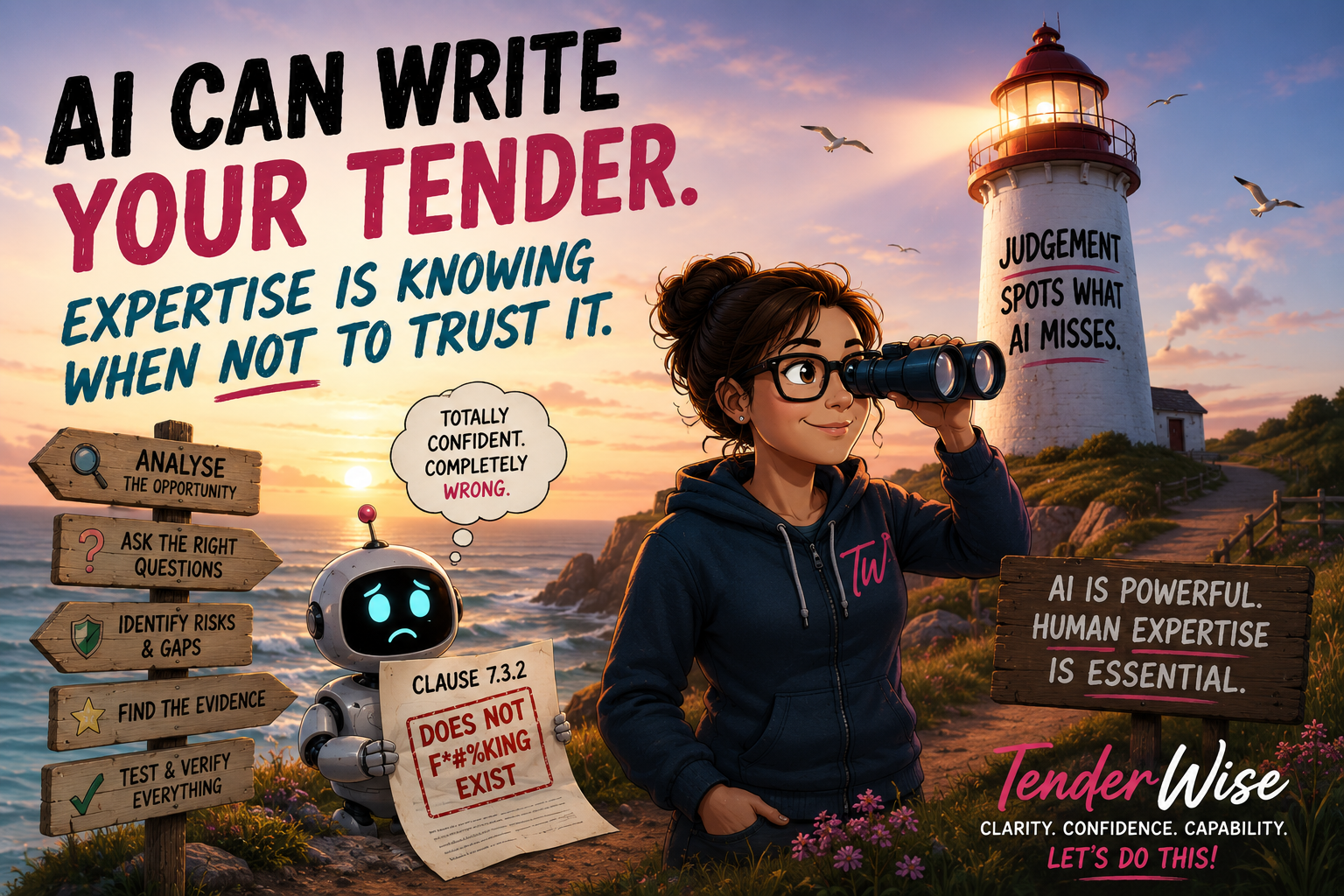
A polished answer can still be the wrong answer
AI is extraordinarily persuasive.
It can analyse a requirement and provide a beautifully structured response explaining your compliance.
It can also misunderstand the requirement, overlook an important condition, apply a requirement that belongs to another part of the contract or occasionally invent something entirely.
And it may do all of those things with exactly the same confidence it displays when it's correct.
That's where experience matters.
When I review a tender opportunity, I'm not simply looking for something to write in each response box.
I'm looking at the procurement as a whole.
What is the buyer really evaluating?
Which requirements apply to the client's particular scope?
Are there inconsistencies between the specification, contract and pricing schedule?
What assumptions are we making?
What evidence supports our claims?
What hasn't the client told me yet?
Where are the commercial risks?
What should we clarify before the tender closes?
And what has AI just told me that doesn't quite smell right?
I use AI too
I'm not going to tell clients that professional tender writers possess some magical human ability that technology can never replicate.
That would be nonsense.
I use AI because it makes me better and faster at parts of my job.
It can interrogate enormous documents, test ideas, find information and help me explore different approaches in seconds.
But I don't outsource my judgement to it.
The technology brings extraordinary processing capability.
I bring years of tender experience, knowledge of procurement, commercial judgement, understanding of my client's business and, importantly, the ability to recognise when something isn't right.
That's the combination I believe matters.
Tender writing is becoming tender strategy
I suspect AI will change my profession substantially.
Some businesses that previously engaged tender writers will decide to do the work themselves.
That's inevitable.
But I think it will also expose something we've perhaps failed to explain very well as an industry:
Good tender writing was never really about the writing.
It's about understanding the opportunity.
Understanding the business.
Finding the evidence.
Asking the questions nobody has asked yet.
Recognising risk.
Making strategic decisions about what matters.
And ultimately presenting a credible, compelling case that makes it easy for an evaluator to understand why your business is capable of delivering the contract.
AI is becoming very good at helping with that process.
So am I worried that AI can write tenders?
Not particularly.
I'm much more interested in helping businesses use everything available to them — including AI — without mistaking a confident answer for a correct one.
Because every now and then, AI will give you three beautifully written paragraphs about a clause that does not fucking exist.
And somebody needs to notice.
TenderWise — Clarity. Confidence. Capability. Let's do this!