
Case Study Development
Turn Your Project Experience Into Evidence
You've completed the project.
Solved the problems.
Managed the client, the people, the deadlines and the inevitable things that didn't quite go according to plan.
And then, when a tender asks for examples of relevant experience, you write:
“We successfully completed a similar project for Client X in 2025.”
Technically true.
Also a spectacular waste of a perfectly good project story. 😂
A well-developed case study turns your past experience into evidence of what your business is capable of delivering next.
TenderWise develops concise, professional project case studies that capture the challenge, your approach, what your team actually did and the outcomes you achieved - usually in just one or two pages.
Your Experience Is Only Valuable If the Evaluator Can See Why It Matters
Tender responses regularly ask for examples of similar projects, previous experience or demonstrated capability.
The temptation is to provide the basics:
Client. Project. Date. Contract value. Scope.
Those details matter.
But they don't necessarily tell an evaluator very much about your capability.
What made the project challenging?
What was your business responsible for?
What problems did you solve?
How did your people, systems or processes contribute?
Did circumstances change?
How did you respond?
What was the result?
And most importantly:
Why does this project give the evaluator confidence that you can deliver their contract?
That's the story a strong case study needs to tell.
From Project Summary to Evidence
A TenderWise case study isn't intended to become a three-volume corporate biography.
Quite the opposite.
Most case studies I develop are one or two pages. Occasionally a complex project justifies a third, but more isn't automatically better.
The aim is to capture the strongest evidence and make it easy to understand.
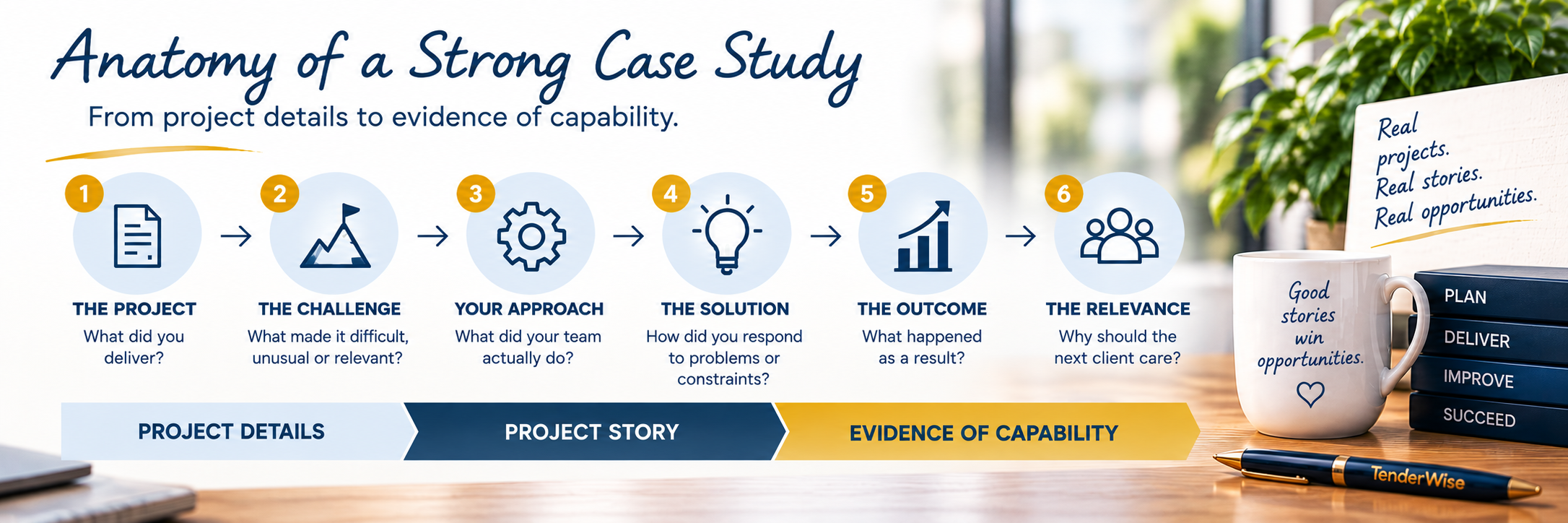
Depending on the project, that might include:
The Project
Who the client was, what you delivered, when you delivered it and the scale or complexity involved.
The Challenge
The circumstances that made the project interesting, difficult or particularly relevant.
Your Approach
How you planned and delivered the work, including the people, systems, methodology or controls involved.
Problems & Solutions
What happened when things didn't go exactly according to plan — because some of the best evidence of capability comes from how a business responds when they don't.
Outcomes
Results, improvements, performance measures, client outcomes or other evidence of successful delivery.
Relevance
The connection between that experience and the opportunity you're pursuing now.
In other words:
What did you do? How did you do it? What happened? Why should your next client care?
The Best Part of the Story Isn't Always Obvious
This is where my questions come in.
If I ask about a project, the first answer might be:
“Everything went well. We finished on time and the client was happy.”
Lovely.
But we're not finished. 😂
What was difficult about it?
Was the site operational while you worked?
Did you have a tight mobilisation period?
Were there difficult access requirements?
Did you have to coordinate multiple subcontractors?
Did the scope change?
Was there an unexpected problem?
Did you introduce a better way of doing something?
Did you reduce disruption, improve safety, save time or solve something the client hadn't anticipated?
Quite often, the detail a business owner considers completely ordinary is exactly the detail that demonstrates experience, judgement, flexibility or capability.
My job is to find it.
One Project Can Demonstrate More Than One Thing
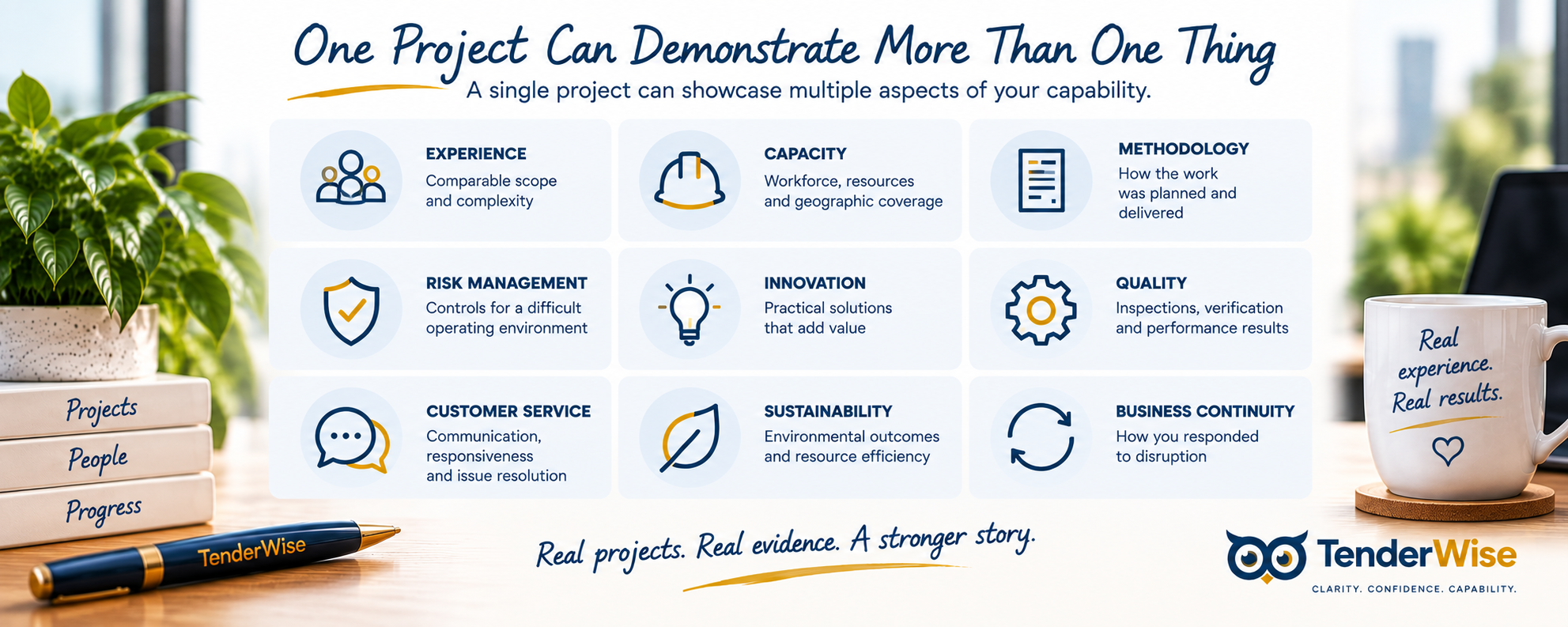
A good case study isn't necessarily evidence of just one capability.
The same project might demonstrate:
Experience through comparable scope and complexity.
Capacity through the size of the workforce, geographic coverage or resources deployed.
Methodology through the way the work was planned and delivered.
Risk management through the controls used to manage a difficult operating environment.
Innovation through a practical solution your team developed.
Quality through inspections, verification and performance results.
Customer service through communication, responsiveness and issue resolution.
Sustainability through waste reduction, efficient resource use or another relevant environmental outcome.
Business continuity through the way your team responded to disruption.
That's why I don't simply ask for a paragraph describing the project.
I want to know what actually happened.
Case Studies for Tender Responses
This is probably where case studies work hardest.
A tender may ask for two or three examples of similar contracts or projects, often with prescribed information that must be addressed.
TenderWise can develop project examples specifically for that submission, making sure they respond to the question and demonstrate the aspects of your experience most relevant to the opportunity.
But there's another approach I particularly like.
Build a library of strong project case studies before you desperately need them.
Then, when the next tender arrives, we already have good source material available. We can select the most relevant examples and tailor them to the particular evaluation criteria.
That's considerably nicer than trying to remember exactly what happened on a project from four years ago at 10 pm the night before a tender closes.
Case Studies for Capability Statements
Case studies can also add enormous credibility to a Capability Statement.
Anyone can say:
Experienced. Reliable. Innovative. Client-focused.
The words themselves prove precisely nothing.
A short project example can show those qualities in practice.
Instead of simply telling a prospective client what your business can do, you're showing them where you've already done it.
Depending on the Capability Statement, we might use a full-page project profile, several shorter project snapshots or selected examples throughout the document.
You Don't Need Perfect Information to Get Started
My clients sometimes think they need to send me a beautifully documented project history before I can develop a case study.
You don't.
Send me what you have.
It might be a project list, contract details, tender response, completion report, photographs, client email, spreadsheet, old Capability Statement - or a few notes telling me what you remember.
Then I'll start asking questions.
We'll fill in the gaps, identify what's useful and separate genuinely valuable evidence from information that's simply taking up space.
You bring the project knowledge. I'll help uncover the story.
Numbers Are Great - But Evidence Isn't Always a Number
Measurable results are fantastic when they're available.
Completion ahead of schedule. Reduced incidents. Response times. Service levels. Waste diverted. Cost savings. KPI results. Volumes processed. Sites serviced.
But not every worthwhile outcome comes with a percentage attached.
Evidence might also include:
A complex problem successfully resolved
Continuity maintained during disruption
Positive client feedback
A difficult mobilisation successfully completed
Repeat or extended work
An innovative solution adopted
A strong safety outcome
Successful coordination with stakeholders
A practical improvement introduced during delivery.
I use the strongest evidence the project genuinely gives me. I don't manufacture a metric because someone once said every case study needs one.
The Finished Case Study
The final result should be concise, visually clear and easy to reuse. Depending on what you need, your case study can incorporate:
Project and client information
Scope and key deliverables
Project imagery
The challenge and operating environment
Your methodology or approach
Key personnel and resources
Problems encountered and solutions implemented
Results and outcomes
Client feedback or testimonials where available;
The specific capabilities the project demonstrates.
Most importantly, it should sound like your business and your project - not a generic marketing piece with some impressive adjectives sprinkled over it.
Your Next Tender Might Need the Story You're Delivering Today
Every completed project gives your business more than revenue.
It gives you experience.
Potentially a referee.
Lessons learned.
Evidence of your systems.
Evidence of your people.
Evidence of your ability to solve problems.
And another example of what your business can deliver.
The trick is capturing that knowledge before everybody moves on to the next job and the useful details disappear.
Real projects. Real experience. Real evidence.
That's what makes a case study valuable.
Got a Project Worth Talking About?
It doesn't need to be the biggest project you've ever delivered.
It needs to be a project that says something useful about what your business can do.
Send me the information you have and we'll work out what story is hiding in it.
And yes - I'll probably ask more questions than you expected.
Clarity. Confidence. Capability. Let's do this!