
Tendering doesn't Start when the RFT Lands
There is a particular moment I see quite often. An email arrives. There's an RFT attached. Someone opens it.
And suddenly a perfectly sensible business is trying to locate five years of project history, update three CVs, find an insurance certificate, work out whether anyone has ever written down the mobilisation process, remember which client gave them that brilliant testimonial in 2022, and discover whether the environmental policy sitting in a folder called FINAL Policies is actually the final policy.
The tender might have been released that morning.
But the work needed to respond to it started years ago.
The business just didn't know it.
The Best Tender Evidence usually already exists
When I start working with a client, I rarely begin by asking:
"What can we say that sounds impressive?"
I'm much more interested in:
"What can we prove?"
Because most good tender responses aren't built from clever adjectives.
They're built from things the business has actually done.
The contract you've delivered for eight years.
The client who keeps renewing.
The supervisor who started with the business 12 years ago and knows the operation backwards.
The system that records every work order from receipt through to completion.
The monthly report showing 98% of jobs were completed within the required timeframe.
The subcontractor you've worked with successfully on 40 projects.
The process your operations manager follows whenever something goes wrong.
That's tender material.
The problem is that businesses don't usually think of it that way.
To you, it's just running the business.
Then the Tender Lands
Now imagine the tender gives you four weeks to respond.
At first, four weeks sounds quite civilised.
Then you start reading.
They want three relevant project examples.
They want CVs for key personnel.
They want evidence of performance.
They want your mobilisation methodology.
They want details of your subcontractor management process.
They want safety statistics.
They want environmental initiatives.
They want examples of innovation.
They want social procurement outcomes.
They want client referees.
They want evidence to support half of the things you've just told them.
And suddenly four weeks doesn't feel quite so generous.
Particularly when everyone who has the answers is also trying to run the business.
Tender-ready Businesses have a Definite Head Start
Being tender-ready doesn't mean having a beautifully written generic tender sitting in a folder waiting for the next opportunity.
In fact, I wouldn't recommend that at all.
Every tender is different. The buyer is different. The scope is different. The risks are different. The evaluation criteria are different.
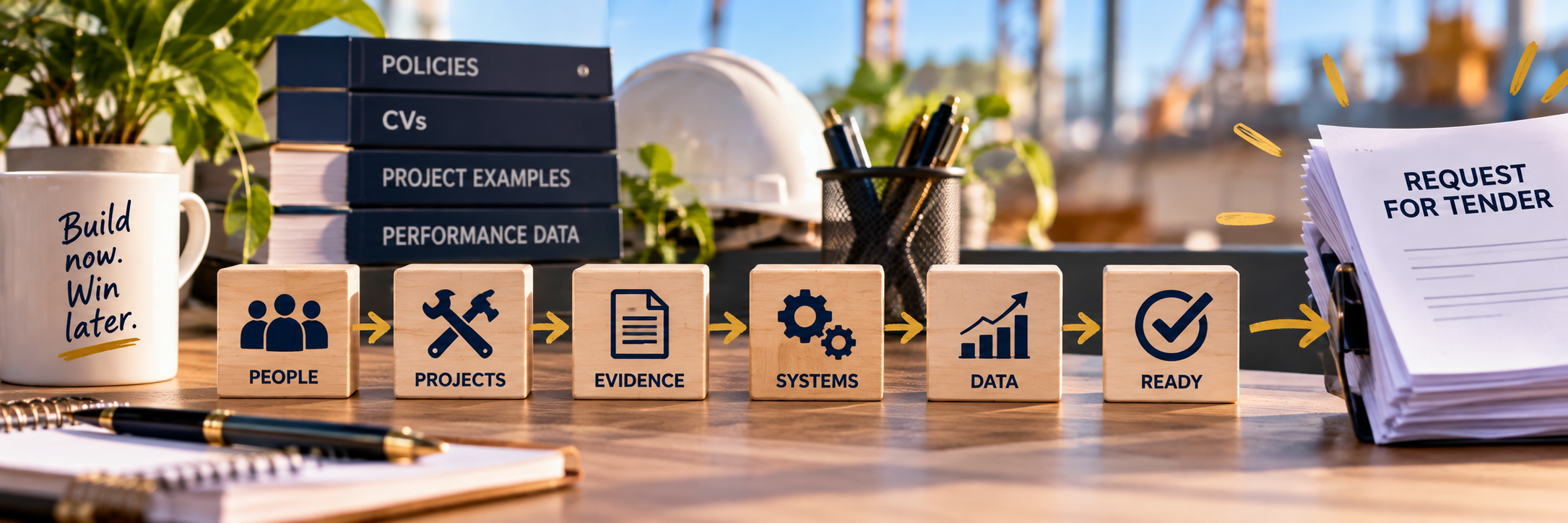
Being tender-ready means having the building blocks available.
Things like:
Current company information and organisational structure.
Up-to-date licences, accreditations and insurance details.
Strong project examples with useful facts and results.
Current CVs for key personnel.
Client testimonials and referee details.
Safety, quality and environmental information.
Performance data and KPIs.
Policies and management plans.
Details of systems and technology.
Examples of innovation and continuous improvement.
Social procurement, sustainability and community initiatives.
Good photographs of projects, people, equipment and facilities.
A record of lessons learned and improvements made.
You won't necessarily use all of it.
But when the tender asks the question, you're not beginning with:
"Does anyone know where we might find this?"
That's a significant advantage.
Start Building your Project Stories now
This is probably one of the biggest missed opportunities I see.
A business finishes a great project.
Everyone moves on to the next one.
Two years later, a tender asks for an example of a comparable project and somebody tries to reconstruct what happened from memory.
What was the contract value?
How many people were involved?
What was unusual about it?
What problems did you solve?
Were there any measurable results?
Did you finish early?
Did you reduce downtime?
Did the client renew?
Was there a safety challenge?
Did you introduce a better way of doing something?
Who was the Project Manager?
Can we still use the client as a referee?
And inevitably:
"I'm pretty sure Dave would know, but Dave left last year."
Don't wait.
When a significant project finishes, capture the story while everyone still remembers it.
Not just the contract name, dates and value.
Capture why it was difficult, what you did and what happened as a result.
That's the part we'll actually want when the tender arrives.
Your People need Stories too
The same applies to CVs.
Tender CVs aren't quite the same as employment CVs.
I don't particularly care that your Operations Manager is "a highly motivated professional with excellent communication skills".
I'm far more interested in the fact that she has:
15 years' industry experience, managed contracts worth $8 million annually, supervised a workforce of 65 people, mobilised three major contracts and retained responsibility for a client relationship that has lasted nine years.
Now I have something useful.
Keep CVs current.
Record major projects as they're completed.
Capture new qualifications.
Record promotions and increasing responsibilities.
Otherwise, when the tender lands, somebody is inevitably trying to update six CVs at 9.30 pm on a Tuesday.
Write Down how you Actually do Things
This one fascinates me.
I'll ask:
"What happens when an urgent job comes in?"
And the client gives me a brilliant five-minute explanation.
The request goes here.
This person assesses it.
It's classified according to these criteria.
The nearest appropriately qualified person is allocated.
The client gets an acknowledgement.
The technician attends.
If it can't be fixed immediately, this happens.
Photos are taken.
The system is updated.
The supervisor reviews the work.
The client receives the close-out report.
Perfect.
"Do you have that process written down anywhere?"
No.
Of course not.
It's in someone's head.
Tender readiness means gradually getting those processes out of people's heads.
Not because every business needs another 147-page procedure manual.
But because understanding your own processes makes it much easier to explain them convincingly to someone else.
Keep the Numbers
This is another big one.
Tenderers love saying:
Reliable. Responsive. Experienced. High quality.
Evaluators have read those words approximately eleven billion times.
Numbers are more interesting.
If you have them, keep them.
Response times.
Completion rates.
Customer satisfaction.
Repeat business.
Contract renewals.
Safety performance.
Environmental outcomes.
Waste diversion.
Training hours.
Local expenditure.
Apprentices employed.
Aboriginal participation.
Preventive maintenance completion.
Defect rates.
Staff retention.
Whatever makes sense for your business.
You don't need to measure things purely because they might appear in a tender.
But if you're already collecting useful operational data, don't let it disappear into a monthly report nobody will ever look at again.
That data may become some of your strongest evidence.
Keep the Nice Emails too
Yes, really.
The client sends an email saying your team did an exceptional job responding to an emergency.
Keep it.
Someone writes to thank your supervisor for handling a difficult situation brilliantly.
Keep it.
A client tells you they've never had such a smooth mobilisation.
Definitely keep that.
You don't need to frame every complimentary email and hang it in reception.
But create somewhere to store them.
Because three years from now, I may ask:
"Do you have any evidence that clients are happy with your service?"
And I'd much rather hear:
"Actually, yes."
than:
"They seem happy."
Get your Policies under Control
Nothing brings joy to a tender deadline quite like discovering that the tender requires a policy nobody can find.
Except perhaps discovering that you have four versions of it.
Environmental Policy FINAL.docx
Environmental Policy FINAL V2.docx
Environmental Policy FINAL USE THIS ONE.docx
Environmental Policy NEW FINAL signed.pdf
You know who you are.
Tender readiness includes some deeply unglamorous housekeeping.
Know what policies you have.
Know which versions are current.
Know when they need review.
Make sure they're approved and signed where appropriate.
And if your business says it operates under a particular process, make sure the documentation bears some resemblance to what actually happens.
Look at Opportunities before you Intend to Bid
You don't have to wait until you're ready to tender before looking at tenders.
In fact, don't.
Download opportunities in your industry.
Look at what buyers ask.
What policies keep appearing?
What accreditations are expected?
What information do they request about previous projects?
What performance data do they want?
What social procurement questions are becoming common?
What systems do they expect suppliers to have?
You may decide not to bid for any of them.
That's fine.
You're learning what the market expects.
And if you keep seeing the same requirement that your business can't currently demonstrate, you've discovered that before the perfect opportunity lands.
That's useful information.
Decide what you won't Bid for
Tender readiness isn't only about becoming better prepared to bid.
It's also about becoming better prepared to say:
No.
Not every tender deserves your time.
Before the RFT arrives, think about the type of work your business actually wants.
Contract size.
Location.
Client type.
Required resources.
Risk.
Margins.
Contract duration.
Strategic value.
Experience requirements.
Whether you can genuinely deliver it.
Because one of the easiest ways to waste an enormous amount of time is to become emotionally attached to an opportunity simply because somebody has published it.
An available tender is not automatically a good tender for your business.
How do you know if you should bid?
Before you start preparing your next tender, use our free Bid / No-Bid Quick Check to decide whether the opportunity genuinely deserves your time.
Build the Library - but don't Build a Frankenstein Tender
Over time, a tender-ready business can develop an incredibly useful library.
Project examples.
CVs.
Methodologies.
Process descriptions.
Statistics.
Policies.
Graphics.
Mobilisation approaches.
Risk information.
Case studies.
Testimonials.
That's excellent.
What you don't want is a giant generic response assembled by copying chunks from six previous tenders and hoping nobody notices.
That's how we end up with:
The wrong client name.
The wrong contract.
A methodology written for a completely different service.
A promise you made three years ago that nobody remembers.
And occasionally a paragraph that appears to have wandered in from another company entirely.
Your library gives you raw material.
The new tender still needs to be built around the buyer's requirements.
Every Tender should make the Next one Easier
This is the other side of tender readiness.
Once you've completed a tender, don't simply lodge it and forget it existed.
You've probably just created or improved a considerable amount of business information.
Maybe you've finally documented your mobilisation process.
Updated five CVs.
Written three strong project examples.
Found useful performance statistics.
Created a better subcontractor management methodology.
Pulled together your environmental initiatives.
Built an organisational chart.
Updated your risk register.
Keep the good material.
Then improve it as the business changes.
Even if you don't win that particular contract, the work doesn't necessarily disappear.
Every tender can make the business better prepared for the next one.
The RFT should be the Trigger - not the Starting Gun
You can't write the final tender before you know what the buyer is asking.
And you shouldn't try.
But you can make sure that when the opportunity arrives, you're not spending the first half of the response period trying to reconstruct your own business.
Know your capability.
Capture your evidence.
Keep your documents current.
Record your successes.
Understand your processes.
Watch the market.
And build the information you'll eventually need to prove what your business can do.
Then, when the right RFT lands, you can spend your time doing what actually matters:
Working out what this buyer needs - and showing them why your business can deliver it.
Want to get Tender-ready before the Next RFT Lands?
You don't need a live tender to start getting your business ready.
TenderWise can help identify the information, evidence and supporting material that will make future submissions easier - from project examples and methodologies to CVs, capability information and tender-ready content.
You know your business. We know what evaluators will want to see.